Posts

Men who are skinny-fat: There are quite a few of them
Image
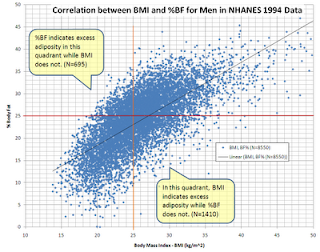
The graph below (from Wikipedia) plots body fat percentage (BF) against body mass index (BMI) for men. The data is a bit old: 1994. The top-left quadrant refers to men with BF greater than 25 percent and BMI lower than 25. A man with a BF greater than 25 has crossed into obese territory, even though a BMI lower than 25 would suggest that he is not even overweight. These folks are what we could call skinny-fat men. The data is from the National Health and Nutrition Examination Survey (NHANES), so it is from the USA only. Interesting that even though this data is from 1994, we already could find quite a few men with more than 25 percent BF and a BMI of around 20. One example of this would be a man who is 5’11’’, weighing 145 lbs, and who would be technically obese! About 8 percent of the entire sample of men used as a basis for the plot fell into the area defined by the top-left quadrant – the skinny-fat men. (That quadrant is one in which the BMI measure is quite deceiving; another is t...

Refined carbohydrate-rich foods, palatability, glycemic load, and the Paleo movement

Image
A great deal of discussion has been going on recently revolving around the so-called “carbohydrate hypothesis of obesity”. I will use the acronym CHO to refer to this hypothesis. This acronym is often used to refer to carbohydrates in nutrition research; I hope this will not cause confusion. The CHO could be summarized as this: a person consumes foods with “easily digestible” carbohydrates, those carbohydrates raise insulin levels abnormally, the abnormally high insulin levels drive too much fat into body fat cells and keep it there, this causes hunger as not enough fat is released from fat cells for use as energy, this hunger drives the consumption of more foods with “easily digestible” carbohydrates, and so on. It is posited as a feedback-loop process that causes serious problems over a period of years. The term “easily digestible” is within quotes for emphasis. If it is taken to mean “refined”, which is still a bit vague, there is a good amount of epidemiological evidence in support...