Posts

Showing posts with the label omega-6

Could we have evolved traits that are detrimental to our survival?

Image
Let us assume that we collected data on the presence or absence of a trait (e.g., propensity toward risky behavior) in a population of individuals, as well as on intermediate effects of the trait, downstream effects on mating and survival success, and ultimately on reproductive success (a.k.a. “fitness”, in evolutionary biology). The data would have been collected over several generations. Let us also assume that we conducted a multivariate analysis on this data, of the same type as the analyses employing WarpPLS that were discussed here in previous posts ( ). The results are summarized through the graph below. Each of the numbers next to the arrows in the graph below represents the strength of a cause-effect relationship. The number .244 linking “a” and “y” means that a one standard deviation variation in “a” causes a .244 standard deviation increase in “y”. It also means that a one standard deviation variation in “a” causes a 24.4 percent increase in “y” considering the average “y”...
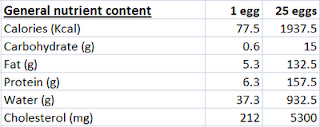
The man who ate 25 eggs per day: What does this case really tell us?

Image
Many readers of this blog have probably heard about the case of the man who ate approximately 25 eggs (20 to 30) per day for over 15 years (probably well over), was almost 90 years old (88) when the case was published in the prestigious The New England Journal of Medicine , and was in surprisingly good health ( ). The case was authored by the late Dr. Fred Kern, Jr., a widely published lipid researcher after whom the Kern Lipid Conference is named ( ). One of Kern’s research interests was bile, a bitter-tasting fluid produced by the liver (and stored in the gallbladder) that helps with the digestion of lipids in the small intestine. He frames the man’s case in terms of a compensatory adaptation tied to bile secretion, arguing that this man was rather unique in his ability to deal with a lethal daily dose of dietary cholesterol. Kern seemed to believe that dietary cholesterol was harmful, but that this man was somehow “immune” to it. This is ironic, because often this case is presented...

Why a fat brain made us more vulnerable to heart disease

Image
Natural selection granted us large brains. The evolutionary cost is having to feed them. The human brain's high-energy demands led to development of a strong preference for fat. We consume more fat than any other primate on average. We are also adapted to more easily digest and metabolize fats. There are two major kinds of fat that our brains depend on most for its development and regular maintenance. These are the long-chain polyunsaturated fatty acids (LC-PUFAs), omega-3 docosahexaenoic acid (DHA) and omega-6 arachidonic (AA). These two LC-PUFAs can't be made de novo , making them essential in the diet. DHA and AA are supplied by seafood, eggs, or animals. They can also be supplied as their 18-carbon precursors alpha-linolenic acid (ALA) and linoleic acid (LA), found mainly in plants and their seeds. ALA and LA precursors require conversion to become long-chained through a series of steps of desaturation and elongation. In particular, delta-5 and delta-6 fatty acid desaturase...

38 g of sardines or 2 fish oil softgels? Let us look at the numbers

Image
The bar chart below shows the fat content of 1 sardine (38 g) canned in tomato sauce, and 2 fish oil softgels of the Nature Made brand. (The sardine is about 1/3 of the content of a typical can, and the data is from Nutritiondata.com. The two softgels are listed as the “serving size” on the Nature Made bottle.) Both the sardine and softgels have some vegetable oil added; presumably to increase their vitamin E content and form a more stable oil mix. This chart is a good reminder that looking at actual numbers can be quite instructive sometimes. Even though the chart focuses on fat content, it is worth noting that the 38 g sardine also contains 8 g of high quality protein. If your goal with the fish oil is to “neutralize” the omega-6 fat content of your diet, which is most people’s main goal, you should consider this. A rough measure of the omega-6 neutralization “power” of a food portion is, by definition, its omega-3 minus omega-6 content. For the 1 canned sardine, this difference is 5...

Nuts by numbers: Should you eat them, and how much?

Image
Nuts are generally seen as good sources of protein and magnesium. The latter plays a number of roles in the human body, and is considered critical for bone health. Nuts are also believed to be good sources of vitamin E. While there is a lot of debate about vitamin E’s role in health, it is considered by many to be a powerful antioxidant. Other than in nuts, vitamin E is not easily found in foods other than seeds and seed oils. Some of the foods that we call nuts are actually seeds; others are legumes. For simplification, in this post I am calling nuts those foods that are generally protected by shells (some harder than others). This protective layer is what makes most people call them nuts. Let us see how different nuts stack up against each other in terms of key nutrients. The quantities listed below are per 1 oz (28 g), and are based on data from Nutritiondata.com. All are raw. Roasting tends to reduce the vitamin content of nuts, often by half, and has little effect on the mineral c...

High-heat cooking will AGE you, if you eat food deep-fried with industrial vegetable oils

As I said before on this blog, I am yet to be convinced that grilled meat is truly unhealthy in the absence of leaky gut problems. I am referring here to high heat cooking-induced Maillard reactions (browning) and the resulting advanced glycation endproducts (AGEs). Whenever you cook a food in high heat, to the point of browning it, you generate a Maillard reaction. Searing and roasting meat usually leads to that. Elevated levels of serum AGEs presumably accelerate the aging process in humans. This is supported by research with uncontrolled diabetics, who seem to have elevated levels of serum AGEs. In fact, a widely used measure in the treatment of diabetes, the HbA1c (or percentage of glycated hemoglobin) , is actually a measure of endogenous AGE formation. (Endogenous = generated by our own bodies.) Still, evidence that a person with an uncompromised gut can cause serum levels of AGEs to go up significantly by eating AGEs is weak, and evidence that any related serum AGE increases lea...

Low omega-6 to omega-3 ratio: Grain-fed meats or industrial vegetable oils?

Image
Just a little note on the use of language. Clearly there is no such a thing as grain-fed or grass-fed beef, because one does not feed beef anything. One feeds cattle grain or grass, and then the resulting beef is said to be “grain-fed” or “grass-fed”. It is a manner of speaking that facilitates discourse, which is why it is used here. To compensate for this digression, let me show you a graph, which pretty much summarizes the "punch line" of this post. The graph below shows the omega-6 fat contents of 1 lb (454 g) of grain-fed beef and 1 tablespoon (roughly 14 g) of a typical industrial vegetable oil (safflower oil). As you can see, there is a lot more omega-6 in the much smaller amount of industrial vegetable oil. A gram-for-gram comparison would practically make the beef content bar disappear. It has been estimated that our Paleolithic ancestors consumed a diet with an omega-6 to omega-3 ratio of about 1 . While other estimates exist, the general consensus seems to be that ...

More on the Harvard study on saturated versus polyunsaturated fats

This is a follow up on this post , which addressed the main argument put forth in a recent BBC article. The BBC article argued that people should replace saturated with polyunsaturated fats to reduce their risk of heart disease. Let us take a look at the actual Harvard study itself (i.e., the study discussed in the BBC article). The Harvard study is linked here . This post , by Stephan Guyenet, already pointed out several problems with the study. Stephan actually reviewed the studies used in the meta-analysis, and also some that were excluded in the meta-analysis and that he believes should have been included. Here are a few other problems, in addition to the ones already pointed out by Stephan: One thing that looks suspicious about this Harvard meta-analysis study is that they say that: “Statistical evidence for substantial between-study heterogeneity was not present (Q-statistic p = 0.13; I2 = 37%).” A meta-analysis is a study that essentially summarizes, in a statistically sophistic...

BBC article's advice: Replace saturated with polyunsaturated fats

The BBC article is here . It is based on meta-analysis of eight previous studies conducted by Harvard researchers, which the article states cover more than 13,000 people. The article also says that: “… [saturated] fats raise the levels of bad cholesterol that block the arteries to the heart.” They are of course referring to LDL cholesterol as the "bad cholesterol". Sourcing bias is a notorious problem with meta-analyses (i.e., the choice of studies to use in a meta-analysis). Another problem is that you cannot tell what the studies sourced controlled for. Consider a study that compares health markers for smokers and non-smokers, where the smokers eat more saturated fat than the non-smokers. This study may confuse the effect of smoking with that of saturated fat consumption. To be reliable, the study must analyze the effect of saturated fat consumption, controlling for smoking habits. There are other statistical issues to be considered in meta-analyses. For example, some of th...

Steamed gulf shrimp with vegetables

Image
Few would argue against eating seafood several times a week, except in the case of seafood allergy. Shrimp is a very good option, especially if it is not farm raised. 100 g of shrimp will typically have 20 g of protein, and about 152 mg of cholesterol (this is good for your health ). It will also have about 0.6 g of omega-3 fats, and 0.03 g of omega-6; an omega-3 to omega-6 ratio of about 20. My wife prepared this steamed gulf shrimp with vegetables dish. And it was very, very delicious. Here is her recipe: - Add a small amount of olive oil and water to a frying pan. - Add 1 lb of wild-caught peeled gulf shrimp, cabbage, onion, and asparagus (or green beans, as in the photo). - Cook in low heat for 15 minutes. - Add spinach and cook in low heat for another 10 minutes. - Turn off heat, season to taste while mixing; I suggest using garlic powder, cumin powder, and parsley flakes. Peeled shrimp is usually farm raised, which does not have the same amount of omega-3, or the same ratio of om...

Eating fish whole: Sardines

Image
Different parts of a fish have different types of nutrients that are important for our health; this includes bones and organs. Therefore it makes sense to consume the fish whole, not just filets made from it. This is easier to do with small than big fish. Small fish have the added advantage that they have very low concentrations of metals, compared to large fish. The reason for this is that small fish are usually low in the food chain, typically feeding mostly on plankton, especially algae. Large carnivorous fish tend to accumulate metals in their body, and their consumption over time may lead to the accumulation of toxic levels of metals in our bodies. One of my favorite types of small fish is the sardine. The photo below is of a dish of sardines and vegetables that I prepared recently. Another small fish favorite is the smelt (see this post ). I buy wild-caught sardines regularly at the supermarket. Sardines are very affordable, and typically available throughout the year. In fact, s...

Go see your doctor, often

As I blog about health issues, and talk with people about them, I often notice that there is a growing contempt for the medical profession. This comes in part from the fact that many MDs are still providing advice based on the mainstream assumption that saturated fat is the enemy. Much recent (and even some old) research suggests that among the main real enemies of good health are: chronic stress, refined carbs, refined sugars, industrial trans-fats, and an omega-6/omega-3 imbalance caused by consumption of industrial vegetable oils rich in omega-6 fats. Because of this disconnect, some people stop seeing their doctors regularly; others avoid doctors completely. Many rely exclusively on Internet advice, from health-related blogs (like this) and other sources. In my opinion, this is a BIG mistake. A good MD has something that no blogger who is not an MD (like me) can have. He or she has direct access to a much larger group of people, and to confidential information that can clarify thin...