Posts

Showing posts with the label evolution

Could we have evolved traits that are detrimental to our survival?

Image
Let us assume that we collected data on the presence or absence of a trait (e.g., propensity toward risky behavior) in a population of individuals, as well as on intermediate effects of the trait, downstream effects on mating and survival success, and ultimately on reproductive success (a.k.a. “fitness”, in evolutionary biology). The data would have been collected over several generations. Let us also assume that we conducted a multivariate analysis on this data, of the same type as the analyses employing WarpPLS that were discussed here in previous posts ( ). The results are summarized through the graph below. Each of the numbers next to the arrows in the graph below represents the strength of a cause-effect relationship. The number .244 linking “a” and “y” means that a one standard deviation variation in “a” causes a .244 standard deviation increase in “y”. It also means that a one standard deviation variation in “a” causes a 24.4 percent increase in “y” considering the average “y”...

We share an ancestor who probably lived no more than 640 years ago

Image
This post is a revised version of a previous post . The original post has been or will be deleted, with the comments preserved. Typically this is done with posts that attract many visits at the time they are published, and whose topics become particularly relevant or need to be re-addressed at a later date. *** We all evolved from one single-celled organism that lived billions of years ago. I don’t see why this is so hard for some people to believe, given that all of us also developed from a single fertilized cell in just 9 months. However, our most recent common ancestor is not that first single-celled organism, nor is it the first Homo sapiens, or even the first Cro-Magnon. The majority of the people who read this blog probably share a common ancestor who lived no more than 640 years ago. Genealogical records often reveal interesting connections - the figure below has been cropped from a larger one from Pinterest . You and I, whoever you are, have each two parents. Each of our parent...

The bipolar disorder pendulum: Depression as a compensatory adaptation

Image
As far as explaining natural phenomena, Darwin was one of the best theoretical researchers of all time. Yet, there were a few phenomena that puzzled him for many years. One was the evolution of survival-impairing traits such as the peacock’s train, the large and brightly colored tail appendage observed in males. Tha male peacock’s train is detrimental to the animal’s survival, and yet it is clearly an evolved trait ( ). This type of trait is known as a “costly” trait – a trait that enhances biological fitness (or reproductive success, not to be confused with “gym fitness”), and yet is detrimental to the survival of the individuals who possess it ( ). Many costly traits have evolved in animals because of sexual selection. That is, they have evolved because they are sexy. Costly traits seem like a contradiction in terms, but the mechanisms by which they can evolve become clear when evolution is modeled mathematically ( , ). There is evidence that mental disorders may have evolved as c...

Why a fat brain made us more vulnerable to heart disease

Image
Natural selection granted us large brains. The evolutionary cost is having to feed them. The human brain's high-energy demands led to development of a strong preference for fat. We consume more fat than any other primate on average. We are also adapted to more easily digest and metabolize fats. There are two major kinds of fat that our brains depend on most for its development and regular maintenance. These are the long-chain polyunsaturated fatty acids (LC-PUFAs), omega-3 docosahexaenoic acid (DHA) and omega-6 arachidonic (AA). These two LC-PUFAs can't be made de novo , making them essential in the diet. DHA and AA are supplied by seafood, eggs, or animals. They can also be supplied as their 18-carbon precursors alpha-linolenic acid (ALA) and linoleic acid (LA), found mainly in plants and their seeds. ALA and LA precursors require conversion to become long-chained through a series of steps of desaturation and elongation. In particular, delta-5 and delta-6 fatty acid desaturase...

Hormonal reductionism is as myopic as biochemical reductionism

Image
Biochemistry-based arguments can be very misleading. Yet, biochemistry can be extremely useful in the elucidation of diet and lifestyle effects that are suggested by well-designed studies of humans. If you start with a biochemistry-based argument though, and ignore actual studies of humans, you can easily convince someone that glycogen-depleting exercise (e.g., weight training) is unhealthy, because many health markers change for the worse after that type of exercise. But it is the damage caused by glycogen-depleting exercise that leads to health improvements, via short- and long-term compensatory adaptations ( ). Biochemistry is very helpful in terms of providing “pieces for the puzzle”, but biochemical reductionism is a problem. Analogous to biochemical reductionism, and perhaps one example of it, is hormonal reductionism – trying to argue that all diet and lifestyle effects are mediated by a single hormone. A less extreme position, but still myopic, is to argue that all diet and lif...

Walking Off The Influence of "Thrifty Genes"

"I can't help it, it's my genes" is a familiar phrase among frustrated dieters and gym goers who feel they can’t make the scale budge despite all efforts to reduce calories and exercise more. There may be something to their justification. After all, weight can depend partly on genetic makeup (among several other factors). Luckily, the genetic revolution continues to churn out exciting news giving us hope that, no, we're not completely left at the mercy of the wrong kind of genes. The latest example is a study presented March 14 at the American Heart Association meeting in San Diego. The study found that people could keep their obesity genes under wraps by doing as little as turning off the tube and taking a brisk walk. The study found that a brisk one-hour walk daily cut the influence of genes on obesity by as much as half! On the other hand, every couple of hours of watching television appeared to increase the influence of obesity genes by a quarter. That can m...

Certain mental disorders may have evolved as costs of attractive mental traits

Image
I find costly traits fascinating, even though they pose a serious challenge to the notion that living as we evolved to live is a good thing . It is not that they always deny this notion; sometimes they do not, but add interesting and somewhat odd twists to it. Costly traits have evolved in many species (e.g., the male peacock’s train) because they maximize reproductive success, even though they are survival handicaps. Many of these traits have evolved through nature’s great venture capitalist – sexual selection. (Source: Vangoghart.org) Certain harmful mental disorders in humans, such as schizophrenia and manic–depression, are often seen as puzzles from an evolutionary perspective. The heritability of those mental disorders and their frequency in the population at various levels of severity suggests that they may have been evolved through selection, yet they often significantly decrease the survival prospects of those afflicted by them (Keller & Miller, 2006; Nesse & Williams, ...

Great evolution thinkers you should know about

Image
If you follow a paleo diet, you follow a diet that aims to be consistent with evolution. This is a theory that has undergone major changes and additions since Alfred Russel Wallace and Charles Darwin proposed it in the 1800s. Wallace proposed it first, by the way, even though Darwin’s proposal was much more elaborate and supported by evidence. Darwin acknowledged Wallace's precedence, but received most of the credit for the theory anyway. (Alfred Russel Wallace; source: Wikipedia) What many people who describe themselves as paleo do not seem to know is how the theory found its footing. The original Wallace-Darwin theory (a.k.a. Darwin’s theory) had some major problems, notably the idea of blending inheritance (e.g., blue eye + brown eye = somewhere in between), which led it to be largely dismissed until the early 1900s. Ironically, it was the work of a Catholic priest that provided the foundation on which the theory of evolution would find its footing, and evolve into the grand t...

Evolution of the "Hero's Journey"

Image
When I was a child, my father told me stories of his time spent working for a gold mining company in the Amazon jungle. He brought home tales of fishing for piranhas, evading giant venomous snakes, and nearly being eaten alive by a swarm of ants. Dad also traded with indigenous tribes. My curiosity was piqued by photos of those natives, so shockingly naked, and their beautifully crafted bows and arrows. Dad had one on display that he had acquired in exchange for a pair of jeans, which my brother and I used to play with until it almost broke (leading to a stern warning). Dad's stories have stuck with me to this day and I've often reflected on the influence they’ve had on my life. Each story had a some sort of moral in it, although I didn't know it. They’ve guided me in all sorts of situations, be they social, financial or otherwise. Now, as if following wise ancient tradition, he tells these same stories to my children and nephews, his grandchildren. Evolution of storytellin...

What chimpanzee predatory behavior can tell us about early human diets

Image
Among primates, we humans are unique in how much meat we eat. On average we eat 10 times as much meat as chimpanzees, who eat the most meat among wild apes. And, unlike any other primate, humans specialize in eating big-game animals (larger than ourselves) like reindeer and mammoths.  Because of how much meat humans eat, a few major questions are under discussion among biologists and anthropologists:  What role did meat play in human evolution?   How much meat did human ancestors really eat early on? Cutmarks on bones, unfortunately, don't say much about whether meat was eaten once a day, once a week, or once a month. But could a few clues into early human diets be gleaned from the extensive field research into the predatory nature of wild chimps? Biological anthropologist Craig Stanford says he gained a research window into studying chimpanzee meat-eating because Jane Goodall, a committed vegetarian, found the chimp's brutality too morally repugnant and awful t...

Men who are skinny-fat: There are quite a few of them

Image
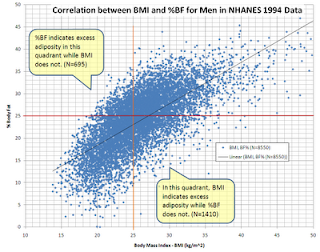
The graph below (from Wikipedia) plots body fat percentage (BF) against body mass index (BMI) for men. The data is a bit old: 1994. The top-left quadrant refers to men with BF greater than 25 percent and BMI lower than 25. A man with a BF greater than 25 has crossed into obese territory, even though a BMI lower than 25 would suggest that he is not even overweight. These folks are what we could call skinny-fat men. The data is from the National Health and Nutrition Examination Survey (NHANES), so it is from the USA only. Interesting that even though this data is from 1994, we already could find quite a few men with more than 25 percent BF and a BMI of around 20. One example of this would be a man who is 5’11’’, weighing 145 lbs, and who would be technically obese! About 8 percent of the entire sample of men used as a basis for the plot fell into the area defined by the top-left quadrant – the skinny-fat men. (That quadrant is one in which the BMI measure is quite deceiving; another is t...

Intermittent fasting for cardiovascular health

At a time when our ancestors existed as hunter-gatherers in the Paleolithic, it's clear that food was not always available and that the fluctuation of feast and famine was probably more apparent. The theory of thrifty genes has it that our metabolic function is dependent on these fluctuations for optimal insulin function. So, it's hypothesized that since intermittent fasting may have been instrumental in the selection of our genes, its practice may have lasting benefits on insulin sensitivity. Findings to date in humans are that fasting does improve insulin sensitivity by inducing increases in circulating adiponectin along with changes in plasma leptin. By these mechanisms, intermittent fasting acts on increasing insulin's action differently than physical activity. Now, new research is showing that fasting one day each month may lower the risk of cardiovascular disease, according to research cardiologists from Salt Lake City. They observed 200 subjects, most being members o...

Fitness, hunter-gatherer style

Image
Aché man hunting. Credit: Wiki “So the bottom line is that foragers are often in good shape and they look it. They sprint, jog, climb, carry, jump, etc all day long but are not specialists.” The quote above is excerpted from a description given by anthropologist Kim Hill (whose work I've previously written about here ) of his experience observing the behaviors of the Aché of Paraguay and the Hiwi of Venezuela. The ASU professor, who has been living and studying the tribes for more than 30 years, recently had his work highlighted in a commentary published in Progress in Cardiovascular Diseases . The article, whose lead author was James O'Keefe, MD, examines the daily physical activity patterns among hunter gatherers and fossil hominins. According to the authors, ancestral hunter-gatherers expended as much as five times more amounts of energy on physical activity than the average modern sedentary adult. Based on data from Cordain's earlier work and that of colleagues, the ...

How Neandertals Lived, Hunted, and Ate

Image
This Discovery Channel series "Neanderthal" presents a wonderful re-enactment of how Neandertals lived in small groups, how they hunted together, and how they ate. I was especially taken by how much we know about the way they used tools to butcher meat, scraped animal hides (by holding the hides in their teeth and face as a tool to spread the stress around the skull) for use in making clothing (shown in Part 1). It's amazing that we know so much about these ancient peoples -- how strong they were, how intelligent, how adaptive, as said in the documentary. The scientific techniques mentioned that lend to our understanding of Neandertals are studies on fossilized feces, worn-out teeth from scraping animal hides, and bone fractures that reveal injuries that led to illness or death. New Neandertal Study I wonder what changes will have to be realized to this documentary in light of new research  from the Journal of Human Evolution . The linked article reports that new findings...