Posts

Showing posts with the label LDL

Sudden cholesterol increase? It may be psychological

Image
There are many published studies with evidence that cholesterol levels are positively associated with heart disease. In multivariate analyses the effects are usually small, but they are still there. On the other hand, there is also plenty of evidence that cholesterol is beneficial in terms of health. Here of course I am referring to the health of humans, not of the many parasites that benefit from disease. For example, there is evidence ( ) that cholesterol levels are negatively associated with mortality (i.e., higher cholesterol leading to lower mortality), and are positively associated with vitamin D production from skin exposure to sunlight ( ). Most of the debris accumulated in atheromas are made up of macrophages, which are specialized cells that “eat” cell debris (ironically) and some pathogens. The drug market is still hot for cholesterol-lowering drugs, often presented in TV and Internet ads as effective tools to prevent formation of atheromas. But what about macrophages? ...

The anatomy of a VAP test report

Image
The vertical auto profile (VAP) test is an enhanced lipid profile test. It has been proposed, chiefly by the company Atherotech ( ), as a more complete test that relies on direct measurement of previously calculated lipid measures. The VAP test is particularly known for providing direct measurements of LDL cholesterol, instead of calculating them through equations ( ). At the time of this writing, a typical VAP test report would provide direct measures of the cholesterol content of LDL, Lp(a), IDL, HDL, and VLDL particles. It would also provide additional measures referred to as secondary risk factors, notably particle density patterns and apolipoprotein concentrations. Finally, it would provide a customized risk summary and some basic recommendations for treatment. Below is the top part of a typical VAP test report (from Atherotech), showing measures of the cholesterol content of various particles. LDL cholesterol is combined for four particle subtypes, the small-dense subtypes 4 and...

Familial hypercholesteromia: Why rely on cholesterol levels when more direct measures are available?

Image
There are two forms of familial hypercholesteromia (FH), namely heterozygous and homozygous FH. In heterozygous FH only one copy of the gene that causes it is present, inherited either from the father or the mother. In homozygous FH, which is the most lethal form, two copies of the gene are present. FH is associated with early-onset cardiovascular disease (CVD). Homozygous FH may happen if both the father and mother have heterozygous or homozygous FH. If both the father and mother have heterozygous FH, the likelihood that at least one in four children will have homozygous FH will be high. If both parents have homozygous FH the likelihood that all children will have homozygous FH will be high. In fact, in the latter case, homozygous FH in the children is almost certain. One case in which it won’t occur is if the combining FH gene from the father or mother mutates into a non-FH gene before it is used in the assembly of the genome of the child. A gene mutation in a specific locus, only ...

The 2012 Atherosclerosis egg study: Plaque decreased as LDL increased with consumption of 2.3 eggs per week or more

Image
A new study by David Spence and colleagues, published online in July 2012 in the journal Atherosclerosis ( ), has been gaining increasing media attention (e.g., ). The article is titled: “Egg yolk consumption and carotid plaque”. As the title implies, the study focuses on egg yolk consumption and its association with carotid artery plaque buildup. The study argues that “regular consumption of egg yolk should be avoided by persons at risk of cardiovascular disease”. It hints at egg yolks being unhealthy in general, possibly even more so than cigarettes. Solid critiques have already been posted on blogs by Mark Sisson, Chris Masterjohn, and Zoe Harcombe ( , , ), among others. These critiques present valid arguments for why the key findings of the study cannot be accepted, especially the finding that eggs are more dangerous to one’s health than cigarettes. This post is a bit different. It uses the data reported in the study to show that it (the data) suggests that egg consumption is act...

Triglycerides, VLDL, and industrial carbohydrate-rich foods

Image
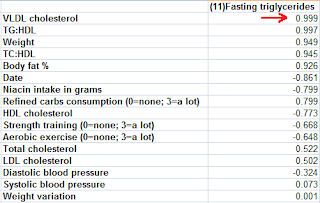
Below are the coefficients of association calculated by HealthCorrelator for Excel (HCE) for user John Doe. The coefficients of association are calculated as linear correlations in HCE ( ). The focus here is on the associations between fasting triglycerides and various other variables. Take a look at the coefficient of association at the top, with VLDL cholesterol, indicated with a red arrow. It is a very high 0.999. Whoa! What is this – 0.999! Is John Doe a unique case? No, this strong association between fasting triglycerides and VLDL cholesterol is a very common pattern among HCE users. The reason is simple. VLDL cholesterol is not normally measured directly, but typically calculated based on fasting triglycerides, by dividing the fasting triglycerides measurement by 5. And there is an underlying reason for that - fasting triglycerides and VLDL cholesterol are actually very highly correlated, based on direct measurements of these two variables. But if VLDL cholesterol is calcula...

Alcohol intake increases LDL cholesterol, in some people

Image
Occasionally I get emails from people experiencing odd fluctuations in health markers, and trying to figure out what is causing those fluctuations. Spikes in LDL cholesterol without any change in diet seem to be a common occurrence, especially in men. LDL cholesterol is a reflection of many things. It is one of the least useful measures in standard lipid profiles, as a predictor of future health problems. Nevertheless, if one’s diet is not changing, whether it is high or low in fat, significant fluctuations in LDL cholesterol may signal a change in inflammatory status. Generally speaking, the more systemic inflammation, the higher is the measured LDL cholesterol. Corella and colleagues (2001) looked into alcohol consumption and its effect on LDL cholesterol, as part of the Framingham Offspring Study. They split the data into three genotypes, which are allele combinations. Alleles are genes variations; that is, they are variations in the sections of DNA that have been identified as cod...

Interview with Jimmy Moore, and basics of intima-media thickness and plaque tests

Image
Let me start this post by telling you that my interview with Jimmy Moore is coming up in about a week . Jimmy and I talk about evolution, statistics, and health – the main themes of this blog. We talk also about other things, and probably do not agree on everything. The interview was actually done a while ago, so I don’t remember exactly what we discussed. From what I remember from mine and other interviews (I listen to Jimmy's podcasts regularly), I think I am the guest who has mentioned the most people during an interview – Gary Taubes, Chris Masterjohn, Carbsane, Petro (a.k.a., Peter “the Hyperlipid”), T. Colin Campbell, Denise Minger, Kurt Harris, Stephan Guyenet, Art De Vany, and a few others. What was I thinking? In case you listen and wonder, my accent is a mix of Brazilian Portuguese, New Zealand English (where I am called “Need”), American English, and the dialect spoken in the “country” of Texas. The strongest influences are probably American English and Brazilian Portugu...

The China Study II: Cholesterol seems to protect against cardiovascular disease

Image
First of all, many thanks are due to Dr. Campbell and his collaborators for collecting and compiling the data used in this analysis. This data is from this site , created by those researchers to disseminate the data from a study often referred to as the “China Study II”. It has already been analyzed by other bloggers. Notable analyses have been conducted by Ricardo at Canibais e Reis , Stan at Heretic , and Denise at Raw Food SOS . The analyses in this post differ from those other analyses in various aspects. One of them is that data for males and females were used separately for each county, instead of the totals per county. Only two data points per county were used (for males and females). This increased the sample size of the dataset without artificially reducing variance (for more details, see “Notes” at the end of the post), which is desirable since the dataset is relatively small. This also allowed for the test of commonsense assumptions (e.g., the protective effects of being...

Postprandial glucose levels, HbA1c, and arterial stiffness: Compared to glucose, lipids are not even on the radar screen

Image
Postprandial glucose levels are the levels of blood glucose after meals. In Western urban environments, the main contributors to elevated postprandial glucose are foods rich in refined carbohydrates and sugars. While postprandial glucose levels may vary somewhat erratically , they are particularly elevated in the morning after breakfast. The main reason for this is that breakfast, in Western urban environments, is typically very high in refined carbohydrates and sugars. HbA1c, or glycated hemoglobin, is a measure of average blood glucose over a period of a few months. Blood glucose glycates (i.e., sticks to) hemoglobin, a protein found in red blood cells. Red blood cells are relatively long-lived, lasting approximately 3 months. Thus HbA1c (given in percentages) is a good indicator of average blood glucose levels, if you don’t suffer from anemia or a few other blood abnormalities. Based on HbA1c, one can then estimate his or her average blood glucose level for the previous 3 months or ...

Niacin and its effects on growth hormone, glucagon, cortisol, blood lipids, mental disorders, and fasting glucose levels

Image
Niacin is a very interesting vitamin. It is also known as vitamin B 3 , or nicotinic acid. It is an essential vitamin whose deficiency leads to a dreadful disease known as pellagra . In large doses of 1 to 3 g per day it has several effects on blood lipids, including these: it increases HDL cholesterol, decreases triglycerides, and decreases Lp(a) . Given that this is essentially a reversal of the metabolic syndrome, for those who are on their way to developing it, niacin must really do something good for our body. Niacin is also a powerful antioxidant. The lipid modification effects of niacin are so consistent across a broad spectrum of the population that some companies that commercialize niacin-based products guarantee some measure of those effects. The graphs below (click to enlarge) are from Arizona Pharmaceuticals, a company that commercializes an instant-release niacin formulation called Nialor (see: arizonapharmaceuticals.com). The graphs show the peak effects on HDL cholestero...

The Friedewald and Iranian equations: Fasting triglycerides can seriously distort calculated LDL

Standard lipid profiles provide LDL cholesterol measures based on equations that usually have the following as their inputs (or independent variables): total cholesterol, HDL cholesterol, and triglycerides. Yes, LDL cholesterol is not measured directly in standard lipid profile tests! This is indeed surprising, since cholesterol-lowering drugs with negative side effects are usually prescribed based on estimated (or "fictitious") LDL cholesterol levels. The most common of these equations is the Friedewald equation. Through the Friedewald equation, LDL cholesterol is calculated as follows (where TC = total cholesterol, and TG = triglycerides). The inputs and result are in mg/dl.     LDL = TC – HDL – TG / 5 Here is one of the problems with the Friedewald equation. Let us assume that an individual has the following lipid profile numbers: TC = 200, HDL = 50, and trigs. = 150. The calculated LDL will be 120. Let us assume that this same individual reduces triglycerides to 50, f...

Low fasting triglycerides: A marker for large-buoyant LDL particles

Image
Small-dense LDL particles are particles that are significantly smaller than the gaps in the endothelium. The endothelium is a thin layer of cells that line the interior of arteries. Those gaps are about 25-26 nanometers (nm) in diameter. Small-dense LDL particles can contribute a lot more to the formation of atheromas (atherosclerotic plaques) in predisposed individuals than large-buoyant LDL particles. Note that typically LDL particles are about 23-25 nm in diameter in most people, and yet not everybody develops atheromas. It is illogical to believe that evolution made LDL particles within those ranges of size to harm us, given the size of the gaps in the endothelium, unless you believe in something like this joke theory . There are underlying factors that make individuals much more prone to the development of atheromas than others. One of those factors is chronic inflammation, which is caused by: chronic stress, excessive exercise (aerobic or anaerobic), and a diet rich in refined ca...