Posts

Showing posts with the label glycation

Book review: Perfect Health Diet

Image
Perfect Health Diet is a book that one should own. It is not the type of book that you can get from your local library and just do a quick read over (and, maybe, write a review about it). If you do that, you will probably miss several important ideas that form the foundation of this book, which is a deep foundation. The book is titled “Perfect Health Diet”, not “The Perfect Health Diet”. If you think that this is a mistake, consider that the most successful social networking web site of all time started as “The Facebook”, and then changed to simply “Facebook”; which was perceived later as a major improvement. Moreover, “Perfect Health Diet” makes for a cool and not at all inappropriate acronym – “PHD”. What people eat has an enormous influence on their lives, and also on the lives of those around them. Nutrition is clearly one of the most important topics in the modern world - it is the source of much happiness and suffering for entire populations. If Albert Einstein and Marie Curie w...

Book review: Sugar Nation

Image
Jeff O’Connell is the Editor-in-Chief for Bodybuilding.com , a former executive writer for Men’s Health , and former Editor-in-Chief of Muscle & Fitness . He is also the author of a few bestselling books on fitness. (Source: Bodybuilding.com) It is obvious that Jeff is someone who can write, and this comes across very clearly in his new book, Sugar Nation . Now, with a title like this, Sugar Nation , I was expecting a book discussing trends of sugar consumption in the USA, and the related trends in various degenerative diseases. So when I started reading the book I was slightly put off by what seemed to be a book about a very personal journey, written in the first person by the author. Yet, after reading it for a while I was hooked, and literally could not put the book down. Jeff has managed to write something of a page-turner, combining a harrowing personal account with carefully researched scientific information, about a relatively rare form of type 2 diabetes. Jeff has a genetic...

Strength training plus fasting regularly, and becoming diabetic!? No, it is just compensatory adaptation at work

Image
One common outcome of doing glycogen-depleting exercise (e.g., strength training, sprinting) in combination with intermittent fasting is an increase in growth hormone (GH) levels. See this post for a graph showing the acute effect on GH levels of glycogen-depleting exercise. This effect applies to both men and women, and is generally healthy, leading to improvements in mood and many health markers. It is a bit like GH therapy, with GH being “administered” to you by your own body. Both glycogen-depleting exercise and intermittent fasting increase GH levels; apparently they have an additive effect when done together. Still, a complaint that one sees a lot from people who have been doing glycogen-depleting exercise and intermittent fasting for a while is that their fasting blood glucose levels go up. This is particularly true for obese folks (after they lose body fat), as obesity tends to be associated with low GH levels, although it is not restricted to the obese. In fact, many people d...

Blood glucose variations in normal individuals: A chaotic mess

Image
I love statistics. But statistics is the science that will tell you that each person in a group of 20 people ate half a chicken per week over six months, until you realize that 10 died because they ate nothing while the other 10 ate a full chicken every week. Statistics is the science that will tell you that there is an “association” between these two variables: my weight from 1 to 20 years of age, and the price of gasoline during that period. These two variables are indeed highly correlated, by neither has influenced the other in any way. This is why I often like to see the underlying numbers when I am told that such and such health measure on average is this or that, or that this or that disease is associated with elevated consumption of whatever. Statistical results must be interpreted carefully. Lying with statistics is very easy. A case in point is that of blood glucose variations among normal individuals. Try plotting them on graphs. What do you see? A chaotic mess, even when the...

Blood glucose control before age 55 may increase your chances of living beyond 90

Image
I have recently read an interesting study by Yashin and colleagues (2009) at Duke University’s Center for Population Health and Aging. (The full reference to the article, and a link, are at the end of this post.) This study is a gem with some rough edges, and some interesting implications. The study uses data from the Framingham Heart Study (FHS). The FHS, which started in the late 1940s, recruited 5209 healthy participants (2336 males and 2873 females), aged 28 to 62, in the town of Framingham, Massachusetts. At the time of Yashin and colleagues’ article publication, there were 993 surviving participants. I rearranged figure 2 from the Yashin and colleagues article so that the two graphs (for females and males) appeared one beside the other. The result is shown below (click on it to enlarge); the caption at the bottom-right corner refers to both graphs. The figure shows the age-related trajectory of blood glucose levels, grouped by lifespan (LS), starting at age 40. As you can see fro...

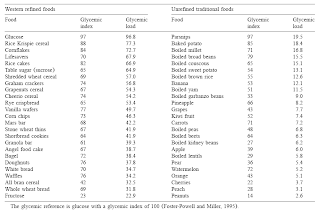
The huge gap between glycemic loads of refined and unrefined carbohydrate-rich foods

Image
I often refer to foods rich in refined carbohydrates in this blog as among the most disease-promoting agents of modern diets. Yet, when one looks at the glycemic indices of foods rich in refined and unrefined carbohydrates, they are not all that different. The glycemic index of a carbohydrate-rich food reflects how quickly the food is digested and generate a blood glucose response. Technically, it is measured as the area under a two-hour blood glucose response curve following the consumption of a portion of the food with a fixed amount of carbohydrates. A measure that reflects much better the underlying difference between foods rich in refined and unrefined carbohydrates is the glycemic load, which is the product of the glycemic index of a food by the carbohydrate content in a 100 g portion of the food. The glycemic load is also the reason for one known fact among diabetics. If a diabetic person eats a very small amount of a high glycemic index food, he or she will have a relatively sm...