Posts

Showing posts with the label alcohol

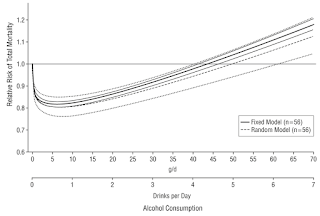
How much alcohol is optimal? Maybe less than you think
Image
I have been regularly recommending to users of the software HCE ( ) to include a column in their health data reflecting their alcohol consumption. Why? Because I suspect that alcohol consumption is behind many of what we call the “diseases of affluence”. A while ago I recall watching an interview with a centenarian, a very lucid woman. When asked about her “secret” to live a long life, she said that she added a little bit of whiskey to her coffee every morning. It was something like a tablespoon of whiskey, or about 15 g, which amounted to approximately 6 g of ethanol every single day. Well, she might have been drinking very close to the optimal amount of alcohol per day for the average person, if the study reviewed in this post is correct. Studies of the effect of alcohol consumption on health generally show results in terms of averages within fixed ranges of consumption. For example, they will show average mortality risks for people consuming 1, 2, 3 etc. drinks per day. These studie...

The “pork paradox”? National pork consumption and obesity

Image
In my previous post ( ) I discussed some country data linking pork consumption and health, analyzed with WarpPLS ( ). One of the datasets used, the most complete, contained data from Nationmaster.com ( ) for the following countries: Australia, Brazil, Canada, China, Denmark, France, Germany, Hong Kong, Hungary, Japan, Mexico, Poland, Russia, Singapore, Spain, Sweden, United Kingdom, and United States. That previous post also addressed a study by Bridges ( ), based on country-level data, suggesting that pork consumption may cause liver disease. In this post we continue that analysis, but with a much more complex model containing the following country variables: wealth (PPP-adjusted GNP/person), pork consumption (lbs/person/year), alcohol consumption (liters/person/year), obesity (% of population), and life expectancy (years). The model and results, generated by WarpPLS, are shown on the figure below. (See notes at the end of this post.) These results are only for direct effects. War...

Does pork consumption cause cirrhosis? Perhaps, if people become obese from eating pork

Image
The idea that pork consumption may cause cirrhosis has been around for a while. A fairly widely cited 1985 study by Nanji and French ( ) provides one of the strongest indictments of pork: “In countries with low alcohol consumption, no correlation was obtained between alcohol consumption and cirrhosis. However, a significant correlation was obtained between cirrhosis and pork.” Recently Paul Jaminet wrote a blog post on the possible link between pork consumption and cirrhosis ( ). Paul should be commended for bringing this topic to the fore, as the implications are far-reaching and very serious. One of the key studies mentioned in Paul’s post is a 2009 article by Bridges ( ), from which the graphs below were taken. The graphs above show a correlation between cirrhosis and alcohol consumption of 0.71, and a correlation between cirrhosis and pork consumption of 0.83. That is, the correlation between cirrhosis and pork consumption is the stronger of the two! Combining this with the Nanji a...

Alcohol intake increases LDL cholesterol, in some people

Image
Occasionally I get emails from people experiencing odd fluctuations in health markers, and trying to figure out what is causing those fluctuations. Spikes in LDL cholesterol without any change in diet seem to be a common occurrence, especially in men. LDL cholesterol is a reflection of many things. It is one of the least useful measures in standard lipid profiles, as a predictor of future health problems. Nevertheless, if one’s diet is not changing, whether it is high or low in fat, significant fluctuations in LDL cholesterol may signal a change in inflammatory status. Generally speaking, the more systemic inflammation, the higher is the measured LDL cholesterol. Corella and colleagues (2001) looked into alcohol consumption and its effect on LDL cholesterol, as part of the Framingham Offspring Study. They split the data into three genotypes, which are allele combinations. Alleles are genes variations; that is, they are variations in the sections of DNA that have been identified as cod...

Alcohol consumption, gender, and type 2 diabetes: Strange … but true

Image
Let me start this post with a warning about spirits (hard liquor). Taken on an empty stomach, they cause an acute suppression of liver glycogenesis. In other words, your liver becomes acutely insulin resistant for a while. How long? It depends on how much you drink; possibly as long as a few hours. So it is not a very good idea to consume them immediately before eating carbohydrate-rich foods, natural or not, or as part of sweet drinks. You may end up with near diabetic blood sugar levels, even if your liver is insulin sensitive under normal circumstances. The other day I was thinking about this, and the title of this article caught my attention: Alcohol Consumption and the Risk of Type 2 Diabetes Mellitus . This article is available here in full text. In it, Kao and colleagues show us a very interesting table (Table 4), relating alcohol consumption in men and women with incidence of type 2 diabetes. I charted the data from Model 3 in that table, and here is what I got: I used the dat...

How much dietary protein can you store in muscle? About 15 g/d if you are a gifted bodybuilder

Image
Let us say you are one of the gifted few who are able to put on 1 lb of pure muscle per month, or 12 lbs per year, by combining strength training with a reasonable protein intake. Let us go even further and assume that the 1 lb of muscle that we are talking about is due to muscle protein gain, not glycogen or water. This is very uncommon; one has to really be genetically gifted to achieve that. And you do that by eating a measly 80 g of protein per day. That is little more than 0.5 g of protein per lb of body weight if you weigh 155 lbs; or 0.4 per lb if you weigh 200 lbs. At the end of the year you are much more muscular. People even think that you’ve been taking steroids; but that just came naturally. The figure below shows what happened with the 80 g of protein you consumed every day. About 15 g became muscle (that is 1 lb divided by 30) … and 65 g “disappeared”! Is that an amazing feat? Yes, it is an amazing feat of waste, if you think that the primary role of protein is to build m...