Posts

Showing posts with the label glycemic load

How to make white rice nutritious

Image
One of the problems often pointed out about rice, and particularly about white rice, is that its nutrition content is fairly low. It is basically carbohydrates with some trace amounts of protein. A 100-g portion of cooked white rice will typically deliver 28 g of carbohydrates, with zero fiber, and 3 g of protein. The micronutrient content of such a portion leaves a lot to be desired when compared with fruits and vegetables, as you can see below (from Nutritiondata.com). Keep in mind that this is for 100 g of “enriched” white rice; the nutrients you see there, such as manganese, are added. White rice is rice that has had its husk, bran, and germ removed. This prevents spoilage and thus significantly increases its shelf life. As it happens, it also significantly reduces both its nutrition and toxin content. White rice is one of the refined foods with the lowest toxin content. Another interesting property of white rice is that it absorbs moisture to the tune of about 2.5 times its weig...

Rice consumption and health

Image
Carbohydrate-rich foods lead to the formation of blood sugars after digestion (e.g., glucose, fructose), which are then used by the liver to synthesize liver glycogen. Liver glycogen is essentially liver-stored sugar, which is in turn used to meet the glucose needs of the human brain – about 5 g/h for the average person. (Source: Wikipedia) When one thinks of the carbohydrate content of foods, there are two measures that often come to mind: the glycemic index and the glycemic load. Of these two, the first, the glycemic index, tends to get a lot more attention. Some would argue that the glycemic load is a lot more important, and that rice, as consumed in Asia, may provide a good illustration of that importance. A 100-g portion of cooked rice will typically deliver 28 g of carbohydrates, with zero fiber, and 3 g of protein. By comparison, a 100-g portion of white Italian bread will contain 54 g of carbohydrates, with 4 g of fiber, and 10 g of protein – the latter in the form of gluten. A...

Refined carbohydrate-rich foods, palatability, glycemic load, and the Paleo movement

Image
A great deal of discussion has been going on recently revolving around the so-called “carbohydrate hypothesis of obesity”. I will use the acronym CHO to refer to this hypothesis. This acronym is often used to refer to carbohydrates in nutrition research; I hope this will not cause confusion. The CHO could be summarized as this: a person consumes foods with “easily digestible” carbohydrates, those carbohydrates raise insulin levels abnormally, the abnormally high insulin levels drive too much fat into body fat cells and keep it there, this causes hunger as not enough fat is released from fat cells for use as energy, this hunger drives the consumption of more foods with “easily digestible” carbohydrates, and so on. It is posited as a feedback-loop process that causes serious problems over a period of years. The term “easily digestible” is within quotes for emphasis. If it is taken to mean “refined”, which is still a bit vague, there is a good amount of epidemiological evidence in support...

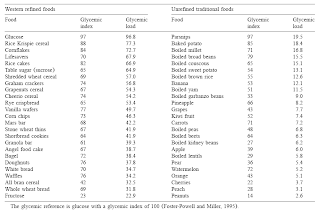
The huge gap between glycemic loads of refined and unrefined carbohydrate-rich foods

Image
I often refer to foods rich in refined carbohydrates in this blog as among the most disease-promoting agents of modern diets. Yet, when one looks at the glycemic indices of foods rich in refined and unrefined carbohydrates, they are not all that different. The glycemic index of a carbohydrate-rich food reflects how quickly the food is digested and generate a blood glucose response. Technically, it is measured as the area under a two-hour blood glucose response curve following the consumption of a portion of the food with a fixed amount of carbohydrates. A measure that reflects much better the underlying difference between foods rich in refined and unrefined carbohydrates is the glycemic load, which is the product of the glycemic index of a food by the carbohydrate content in a 100 g portion of the food. The glycemic load is also the reason for one known fact among diabetics. If a diabetic person eats a very small amount of a high glycemic index food, he or she will have a relatively sm...