Posts

Showing posts with the label muscle loss

The lowest-mortality BMI: What is the role of nutrient intake from food?

Image
In a previous post ( ), I discussed the frequently reported lowest-mortality body mass index (BMI), which is about 26. The empirical results reviewed in that post suggest that fat-free mass plays an important role in that context. Keep in mind that this "BMI=26 phenomenon" is often reported in studies of populations from developed countries, which are likely to be relatively sedentary. This is important for the point made in this post. A lowest-mortality BMI of 26 is somehow at odds with the fact that many healthy and/or long-living populations have much lower BMIs. You can clearly see this in the distribution of BMIs among males in Kitava and Sweden shown in the graph below, from a study by Lindeberg and colleagues ( ). This distribution is shifted in such a way that would suggest a much lower BMI of lowest-mortality among the Kitavans, assuming a U-curve shape similar to that observed in studies of populations from developed countries ( ). Another relevant example come...
The lowest-mortality BMI: What is its relationship with fat-free mass?

Image
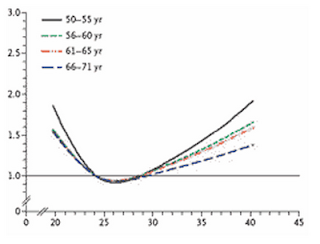
Do overweight folks live longer? It is not uncommon to see graphs like the one below, from the Med Journal Watch blog ( ), suggesting that, at least as far as body mass index (BMI) is concerned ( ), overweight folks (25 < BMI < 30) seem to live longer. The graph shows BMI measured at a certain age, and risk of death within a certain time period (e.g., 20 years) following the measurement. The lowest-mortality BMI is about 26, which is in the overweight area of the BMI chart. Note that relative age-adjusted mortality risk (i.e., relative to the mortality risk of people in the same age group), increases less steeply in response to weight variations as one becomes older. An older person increases the risk of dying to a lesser extent by weighing more or less than does a younger person. This seems to be particularly true for weight gain (as opposed to weight loss). The table below is from a widely cited 2002 article by Allison and colleagues ( ), where they describe a study of 10,169 ...

If your NEAT is low, maybe you should chill

Image
I wrote most of this post a while ago, and then forgot about it. The recent blogosphere storm of comments regarding cold-induced thermogenesis caught me by surprise ( ), and provided a motivation to get this post out. Contrary to popular perception, I guess, cold-induced thermogenesis is an extensively researched topic. Some reasonably well cited references are linked here. Let us backtrack a bit. When people say that they want to lose weight, usually what they really want is to lose is body fat. However, they frequently do things that make them lose what they do not want – muscle glycogen, water, and even some muscle protein. Physical activity in general depletes muscle glycogen; even aerobic physical activity. Walking, for example, depletes muscle glycogen; but slowly, and proportionally to how fast one walks. Weight training and sprints deplete muscle glycogen much faster. Whatever depletes muscle glycogen also lowers the amount of water stored in myocytes (muscle cells), effective...

Gaining muscle and losing fat at the same time: A more customized approach based on strength training and calorie intake variation

Image
In the two last posts I discussed the idea of gaining muscle and losing fat at the same time ( ) ( ). This post outlines one approach to make that happen, based on my own experience and that of several HCE ( ) users. This approach may well be the most natural from an evolutionary perspective. But first let us address one important question: Why would anyone want to reach a certain body weight and keep it constant, resorting to the more difficult and slow strategy of “turning fat into muscle”, so to speak? One could simply keep on losing fat, without losing or gaining muscle, until he or she reaches a very low body fat percentage (e.g., a single-digit body fat percentage, for men). Then he or she could go up from there, slowly putting on muscle. The reason why it is advisable to reach a certain body weight and keep it constant is that, below a certain weight, one is likely to run into nutrient deficiencies . Non-exercise energy expenditure is proportional to body weight. As you keep on...

Gaining muscle and losing fat at the same time: Various issues and two key requirements

Image
In my previous post ( ), I mentioned that the idea of gaining muscle and losing fat at the same time seems impossible to most people because of three widely held misconceptions: (a) to gain muscle you need a calorie surplus; (b) to lose fat you need a calorie deficit; and (c) you cannot achieve a calorie surplus and deficit at the same time. The scenario used to illustrate what I see as a non-traumatic move from obese or seriously overweight to lean is one in which weight loss and fat loss go hand in hand until a relatively lean level is reached, beyond which weight is maintained constant (as illustrated in the schematic graph below). If you are departing from an obese or seriously overweight level, it may be advisable to lose weight until you reach a body fat level of around 21-24 percent for women or 14-17 percent for men. Once you reach that level, it may be best to stop losing weight, and instead slowly gain muscle and lose fat, in equal amounts. I will discuss the rationale for th...

Maybe you should stop trying to be someone you are not

Image
Many people struggle to lose body fat, and never quite make it to their optimal. Fewer people manage to do so successfully, and, as soon as they do, they want more. It is human nature. Often they will start trying to become someone they are not, or cannot be. That may lead to a lot of stress and frustration, and also health problems. Some women have an idealized look in mind, and keep losing weight well beyond their ideal, down to anorexic levels. That leads to a number of health problems. For example, hormones approach starvation levels, causing fatigue and mood swings; susceptibility to infectious diseases increases significantly; and the low weight leads to osteopenia, which is a precursor to osteoporosis. In men, often what happens is the opposite. Guys who are successful getting body fat to healthy levels next want to become very muscular, and fast. They have an idealized look in mind, and think they know how much they should weigh to get there. Sometimes they want to keep losing ...

Do you lose muscle if you lift weights after a 24-hour fast? Probably not if you do that regularly

Image
Compensatory adaptation (CA)  is an idea that is useful in the understanding of how the body reacts to inputs like dietary intake of macronutrients and exercise. CA is a complex process, because it involves feedback loops, but it leads to adaptations that are fairly general, applying to a large cross-section of the population. A joke among software developers is that the computer does exactly what you tell it to do, but not necessarily what you want it to do. Similarly, through CA your body responds exactly to the inputs you give it, but not necessarily in the way you would like it to respond. For example, a moderate caloric deficit may lead to slow body fat loss, while a very high caloric deficit may bring body fat loss to a halt. Strength training seems to lead to various adaptations, which can be understood through the lens provided by CA. One of them is a dramatic increase in the ability of the body to store glycogen, in both liver and muscle. Glycogen is the main fuel used by ...

Does strength exercise increase nitrogen balance?

Image
This previous post  looks at the amounts of protein needed to maintain a nitrogen balance of zero. It builds on data about individuals doing endurance exercise, which increases the estimates a bit. The post also examines the issue of what happens when more protein than is needed in consumed; including by people doing strength exercise. What that post does not look into is whether strength exercise, performed at the anaerobic range, increases nitrogen balance. If it did, it may lead to a counterintuitive effect: strength exercise, when practiced at a certain level of intensity, might enable individuals in calorie deficit to retain their muscle, and lose primarily body fat. That is, strength exercise might push the body into burning more body fat and less muscle than it would normally do under calorie deficit conditions. (Strength exercise combined with a small calorie deficit may be one of the best approaches for body fat loss in women. Photo source: complete-strength-training.com) ...

How much protein does one need to be in nitrogen balance?

Image
The figure below, from Brooks et al. (2005), shows a graph relating nitrogen balance and protein intake. A nitrogen balance of zero is a state in which body protein mass is stable; that is, it is neither increasing nor decreasing. The graph was taken from this classic study by Meredith et al.  The participants in the study were endurance exercisers. As you can see, age is not much of a factor for nitrogen balance in this group. Nitrogen balance is greater than zero (i.e., an anabolic state) for the vast majority of the participants at 1.2 g of protein per kg of body weight per day. To convert lbs to kg, divide by 2.2. A person weighing 100 lbs (45 kg) would need 55 g/d of protein; a person weighing 155 lbs (70 kg) would need 84 g/d; someone weighing 200 lbs (91 kg) would need 109 g/d. The above numbers are overestimations of the amounts needed by people not doing endurance exercise, because endurance exercise tends to lead to muscle loss more than rest or moderate strength trainin...

How lean should one be?

Image
Loss of muscle mass is associated with aging. It is also associated with the metabolic syndrome, together with excessive body fat gain. It is safe to assume that having low muscle and high fat mass, at the same time, is undesirable. The extreme opposite of that, achievable though natural means, would be to have as much muscle as possible and as low body fat as possible. People who achieve that extreme often look a bit like “buff skeletons”. This post assumes that increasing muscle mass through strength training and proper nutrition is healthy. It looks into body fat levels, specifically how low body fat would have to be for health to be maximized. I am happy to acknowledge that quite often I am working on other things and then become interested in a topic that is brought up by Richard Nikoley , and discussed by his readers (I am one of them). This post is a good example of that. Obesity and the diseases of civilization Obesity is strongly associated with the diseases of civilization, o...

Muscle loss during short-term fasting

This is an issue that often comes up in online health discussions, and was the topic of a conversation I had the other day with a friend about some of the benefits of intermittent fasting . Can the benefits of intermittent fasting be achieved without muscle loss? The answer is “yes”, to the best of my knowledge. Even if you are not interested in bulking up or becoming a bodybuilder, you probably want to keep the muscle tissue you have. As a norm, muscle takes a long time, and effort, to build. It is generally easier to lose muscle than it is to gain it. Fat, on the other hand, can be gained very easily. Body fat percentage is positively correlated with measures of inflammation markers and the occurrence of various health problems. Since muscle tissue makes up lean body mass, which excludes fat, it is by definition negatively correlated with inflammation markers and health problems. As muscle mass increases, so does health; as long as the increase in muscle mass is “natural” – i.e., not...