Posts

Showing posts with the label cholesterol

Sudden cholesterol increase? It may be psychological

Image
There are many published studies with evidence that cholesterol levels are positively associated with heart disease. In multivariate analyses the effects are usually small, but they are still there. On the other hand, there is also plenty of evidence that cholesterol is beneficial in terms of health. Here of course I am referring to the health of humans, not of the many parasites that benefit from disease. For example, there is evidence ( ) that cholesterol levels are negatively associated with mortality (i.e., higher cholesterol leading to lower mortality), and are positively associated with vitamin D production from skin exposure to sunlight ( ). Most of the debris accumulated in atheromas are made up of macrophages, which are specialized cells that “eat” cell debris (ironically) and some pathogens. The drug market is still hot for cholesterol-lowering drugs, often presented in TV and Internet ads as effective tools to prevent formation of atheromas. But what about macrophages? ...

Drs. Francisco Cervantes and Marivic Torregosa, and the 2013 Ancestral Health Symposium

Image
Last year I traveled to South Korea to give presentations on nonlinear structural equation modeling and WarpPLS ( ). These are an advanced statistical analysis technique and related software tool, respectively, which have been used extensively in this blog to analyze health data, notably data related to the China Study. I gave a couple of presentations at Korea University, which is in Seoul, and a keynote address at a conference in Gwangju, in the south part of the country. So I ended up seeing quite a lot of this beautiful country, and meeting many people. Some of my impressions regarding health and lifestyle issues need separate blog posts, which are forthcoming. One issue that kept me thinking, as it did when I visited Japan a few years ago as well, was the obvious leanness of the South Koreans, compared with Americans, even though you don’t see a lot of emphasis on dieting there. Interestingly, this phenomenon also poses a challenge to many dietary schools of thought. For examp...

The 2012 Atherosclerosis egg study: More smoking is associated with more plaque, unless you eat more eggs

Image
I blogged before about the study by David Spence and colleagues, published online in July 2012 in the journal Atherosclerosis ( ). This study attracted a lot of media attention (e.g., ). The article is titled: “Egg yolk consumption and carotid plaque”. The study argues that “regular consumption of egg yolk should be avoided by persons at risk of cardiovascular disease”. It hints at egg yolks being unhealthy in general, possibly even more so than cigarettes. I used the numbers in Table 2 of the article (only 5 rows of data, one per quintile; i.e., N=5) to conduct a type of analysis that is rarely if ever conducted in health studies – a moderating effects analysis. A previous blog post summarizes the results of one such analysis using WarpPLS ( ). It looked into the effect of the number of eggs consumed per week on the association between blood LDL cholesterol and plaque (carotid plaque). The conclusion, which is admittedly tentative due to the small sample (N=5), was that plaque decrea...

The man who ate 25 eggs per day: What does this case really tell us?

Image
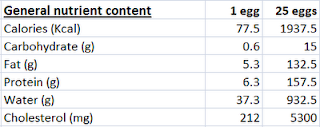
Many readers of this blog have probably heard about the case of the man who ate approximately 25 eggs (20 to 30) per day for over 15 years (probably well over), was almost 90 years old (88) when the case was published in the prestigious The New England Journal of Medicine , and was in surprisingly good health ( ). The case was authored by the late Dr. Fred Kern, Jr., a widely published lipid researcher after whom the Kern Lipid Conference is named ( ). One of Kern’s research interests was bile, a bitter-tasting fluid produced by the liver (and stored in the gallbladder) that helps with the digestion of lipids in the small intestine. He frames the man’s case in terms of a compensatory adaptation tied to bile secretion, arguing that this man was rather unique in his ability to deal with a lethal daily dose of dietary cholesterol. Kern seemed to believe that dietary cholesterol was harmful, but that this man was somehow “immune” to it. This is ironic, because often this case is presented...

Familial hypercholesteromia: Why rely on cholesterol levels when more direct measures are available?

Image
There are two forms of familial hypercholesteromia (FH), namely heterozygous and homozygous FH. In heterozygous FH only one copy of the gene that causes it is present, inherited either from the father or the mother. In homozygous FH, which is the most lethal form, two copies of the gene are present. FH is associated with early-onset cardiovascular disease (CVD). Homozygous FH may happen if both the father and mother have heterozygous or homozygous FH. If both the father and mother have heterozygous FH, the likelihood that at least one in four children will have homozygous FH will be high. If both parents have homozygous FH the likelihood that all children will have homozygous FH will be high. In fact, in the latter case, homozygous FH in the children is almost certain. One case in which it won’t occur is if the combining FH gene from the father or mother mutates into a non-FH gene before it is used in the assembly of the genome of the child. A gene mutation in a specific locus, only ...

The 2012 Atherosclerosis egg study: Plaque decreased as LDL increased with consumption of 2.3 eggs per week or more

Image
A new study by David Spence and colleagues, published online in July 2012 in the journal Atherosclerosis ( ), has been gaining increasing media attention (e.g., ). The article is titled: “Egg yolk consumption and carotid plaque”. As the title implies, the study focuses on egg yolk consumption and its association with carotid artery plaque buildup. The study argues that “regular consumption of egg yolk should be avoided by persons at risk of cardiovascular disease”. It hints at egg yolks being unhealthy in general, possibly even more so than cigarettes. Solid critiques have already been posted on blogs by Mark Sisson, Chris Masterjohn, and Zoe Harcombe ( , , ), among others. These critiques present valid arguments for why the key findings of the study cannot be accepted, especially the finding that eggs are more dangerous to one’s health than cigarettes. This post is a bit different. It uses the data reported in the study to show that it (the data) suggests that egg consumption is act...

Triglycerides, VLDL, and industrial carbohydrate-rich foods

Image
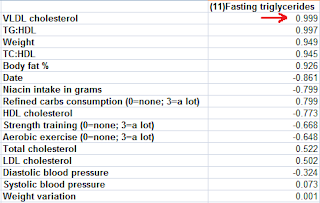
Below are the coefficients of association calculated by HealthCorrelator for Excel (HCE) for user John Doe. The coefficients of association are calculated as linear correlations in HCE ( ). The focus here is on the associations between fasting triglycerides and various other variables. Take a look at the coefficient of association at the top, with VLDL cholesterol, indicated with a red arrow. It is a very high 0.999. Whoa! What is this – 0.999! Is John Doe a unique case? No, this strong association between fasting triglycerides and VLDL cholesterol is a very common pattern among HCE users. The reason is simple. VLDL cholesterol is not normally measured directly, but typically calculated based on fasting triglycerides, by dividing the fasting triglycerides measurement by 5. And there is an underlying reason for that - fasting triglycerides and VLDL cholesterol are actually very highly correlated, based on direct measurements of these two variables. But if VLDL cholesterol is calcula...

Alcohol intake increases LDL cholesterol, in some people

Image
Occasionally I get emails from people experiencing odd fluctuations in health markers, and trying to figure out what is causing those fluctuations. Spikes in LDL cholesterol without any change in diet seem to be a common occurrence, especially in men. LDL cholesterol is a reflection of many things. It is one of the least useful measures in standard lipid profiles, as a predictor of future health problems. Nevertheless, if one’s diet is not changing, whether it is high or low in fat, significant fluctuations in LDL cholesterol may signal a change in inflammatory status. Generally speaking, the more systemic inflammation, the higher is the measured LDL cholesterol. Corella and colleagues (2001) looked into alcohol consumption and its effect on LDL cholesterol, as part of the Framingham Offspring Study. They split the data into three genotypes, which are allele combinations. Alleles are genes variations; that is, they are variations in the sections of DNA that have been identified as cod...

Interview with Jimmy Moore, and basics of intima-media thickness and plaque tests

Image
Let me start this post by telling you that my interview with Jimmy Moore is coming up in about a week . Jimmy and I talk about evolution, statistics, and health – the main themes of this blog. We talk also about other things, and probably do not agree on everything. The interview was actually done a while ago, so I don’t remember exactly what we discussed. From what I remember from mine and other interviews (I listen to Jimmy's podcasts regularly), I think I am the guest who has mentioned the most people during an interview – Gary Taubes, Chris Masterjohn, Carbsane, Petro (a.k.a., Peter “the Hyperlipid”), T. Colin Campbell, Denise Minger, Kurt Harris, Stephan Guyenet, Art De Vany, and a few others. What was I thinking? In case you listen and wonder, my accent is a mix of Brazilian Portuguese, New Zealand English (where I am called “Need”), American English, and the dialect spoken in the “country” of Texas. The strongest influences are probably American English and Brazilian Portugu...

Vitamin D production from UV radiation: The effects of total cholesterol and skin pigmentation

Image
Our body naturally produces as much as 10,000 IU of vitamin D based on a few minutes of sun exposure when the sun is high. Getting that much vitamin D from dietary sources is very difficult, even after “fortification”. The above refers to pre-sunburn exposure. Sunburn is not associated with increased vitamin D production; it is associated with skin damage and cancer. Solar ultraviolet (UV) radiation is generally divided into two main types: UVB (wavelength: 280–320 nm) and UVA (320–400 nm). Vitamin D is produced primarily based on UVB radiation. Nevertheless, UVA is much more abundant, amounting to about 90 percent of the sun’s UV radiation. UVA seems to cause the most skin damage, although there is some debate on this. If this is correct, one would expect skin pigmentation to be our body’s defense primarily against UVA radiation, not UVB radiation. If so, one’s ability to produce vitamin D based on UVB should not go down significantly as one’s skin becomes darker. Also, vitamin D ...

The China Study II: Cholesterol seems to protect against cardiovascular disease

Image
First of all, many thanks are due to Dr. Campbell and his collaborators for collecting and compiling the data used in this analysis. This data is from this site , created by those researchers to disseminate the data from a study often referred to as the “China Study II”. It has already been analyzed by other bloggers. Notable analyses have been conducted by Ricardo at Canibais e Reis , Stan at Heretic , and Denise at Raw Food SOS . The analyses in this post differ from those other analyses in various aspects. One of them is that data for males and females were used separately for each county, instead of the totals per county. Only two data points per county were used (for males and females). This increased the sample size of the dataset without artificially reducing variance (for more details, see “Notes” at the end of the post), which is desirable since the dataset is relatively small. This also allowed for the test of commonsense assumptions (e.g., the protective effects of being...