Posts

Showing posts with the label triglyceride

Triglycerides, VLDL, and industrial carbohydrate-rich foods
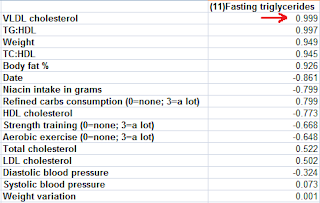
Image
Below are the coefficients of association calculated by HealthCorrelator for Excel (HCE) for user John Doe. The coefficients of association are calculated as linear correlations in HCE ( ). The focus here is on the associations between fasting triglycerides and various other variables. Take a look at the coefficient of association at the top, with VLDL cholesterol, indicated with a red arrow. It is a very high 0.999. Whoa! What is this – 0.999! Is John Doe a unique case? No, this strong association between fasting triglycerides and VLDL cholesterol is a very common pattern among HCE users. The reason is simple. VLDL cholesterol is not normally measured directly, but typically calculated based on fasting triglycerides, by dividing the fasting triglycerides measurement by 5. And there is an underlying reason for that - fasting triglycerides and VLDL cholesterol are actually very highly correlated, based on direct measurements of these two variables. But if VLDL cholesterol is calcula...

Fructose in fruits may be good for you, especially if you are low in glycogen

Image
Excessive dietary fructose has been shown to cause an unhealthy elevation in serum triglycerides. This and other related factors are hypothesized to have a causative effect on the onset of the metabolic syndrome. Since fructose is found in fruits (see table below, from Wikipedia; click to enlarge), there has been some concern that eating fruit may cause the metabolic syndrome. Vegetables also have fructose. Sweet onions, for example, have more free fructose than peaches, on a gram-adjusted basis. Sweet potatoes have more sucrose than grapes (but much less overall sugar), and sucrose is a disaccharide derived from glucose and fructose. Sucrose is broken down to fructose and glucose in the human digestive tract. Dr. Robert Lustig has given a presentation indicting fructose as the main cause of the metabolic syndrome, obesity, and related diseases. Yet, even he pointed out that the fructose in fruits is pretty harmless. This is backed up by empirical research . The problem is over-consump...

Niacin and its effects on growth hormone, glucagon, cortisol, blood lipids, mental disorders, and fasting glucose levels

Image
Niacin is a very interesting vitamin. It is also known as vitamin B 3 , or nicotinic acid. It is an essential vitamin whose deficiency leads to a dreadful disease known as pellagra . In large doses of 1 to 3 g per day it has several effects on blood lipids, including these: it increases HDL cholesterol, decreases triglycerides, and decreases Lp(a) . Given that this is essentially a reversal of the metabolic syndrome, for those who are on their way to developing it, niacin must really do something good for our body. Niacin is also a powerful antioxidant. The lipid modification effects of niacin are so consistent across a broad spectrum of the population that some companies that commercialize niacin-based products guarantee some measure of those effects. The graphs below (click to enlarge) are from Arizona Pharmaceuticals, a company that commercializes an instant-release niacin formulation called Nialor (see: arizonapharmaceuticals.com). The graphs show the peak effects on HDL cholestero...

The Friedewald and Iranian equations: Fasting triglycerides can seriously distort calculated LDL

Standard lipid profiles provide LDL cholesterol measures based on equations that usually have the following as their inputs (or independent variables): total cholesterol, HDL cholesterol, and triglycerides. Yes, LDL cholesterol is not measured directly in standard lipid profile tests! This is indeed surprising, since cholesterol-lowering drugs with negative side effects are usually prescribed based on estimated (or "fictitious") LDL cholesterol levels. The most common of these equations is the Friedewald equation. Through the Friedewald equation, LDL cholesterol is calculated as follows (where TC = total cholesterol, and TG = triglycerides). The inputs and result are in mg/dl.     LDL = TC – HDL – TG / 5 Here is one of the problems with the Friedewald equation. Let us assume that an individual has the following lipid profile numbers: TC = 200, HDL = 50, and trigs. = 150. The calculated LDL will be 120. Let us assume that this same individual reduces triglycerides to 50, f...

Low fasting triglycerides: A marker for large-buoyant LDL particles

Image
Small-dense LDL particles are particles that are significantly smaller than the gaps in the endothelium. The endothelium is a thin layer of cells that line the interior of arteries. Those gaps are about 25-26 nanometers (nm) in diameter. Small-dense LDL particles can contribute a lot more to the formation of atheromas (atherosclerotic plaques) in predisposed individuals than large-buoyant LDL particles. Note that typically LDL particles are about 23-25 nm in diameter in most people, and yet not everybody develops atheromas. It is illogical to believe that evolution made LDL particles within those ranges of size to harm us, given the size of the gaps in the endothelium, unless you believe in something like this joke theory . There are underlying factors that make individuals much more prone to the development of atheromas than others. One of those factors is chronic inflammation, which is caused by: chronic stress, excessive exercise (aerobic or anaerobic), and a diet rich in refined ca...