Posts

Showing posts with the label atherosclerosis

Sudden cholesterol increase? It may be psychological

Image
There are many published studies with evidence that cholesterol levels are positively associated with heart disease. In multivariate analyses the effects are usually small, but they are still there. On the other hand, there is also plenty of evidence that cholesterol is beneficial in terms of health. Here of course I am referring to the health of humans, not of the many parasites that benefit from disease. For example, there is evidence ( ) that cholesterol levels are negatively associated with mortality (i.e., higher cholesterol leading to lower mortality), and are positively associated with vitamin D production from skin exposure to sunlight ( ). Most of the debris accumulated in atheromas are made up of macrophages, which are specialized cells that “eat” cell debris (ironically) and some pathogens. The drug market is still hot for cholesterol-lowering drugs, often presented in TV and Internet ads as effective tools to prevent formation of atheromas. But what about macrophages? ...
How much alcohol is optimal? Maybe less than you think

Image
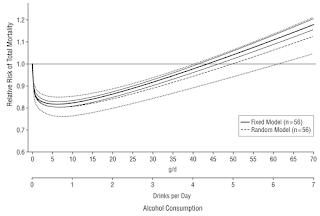
I have been regularly recommending to users of the software HCE ( ) to include a column in their health data reflecting their alcohol consumption. Why? Because I suspect that alcohol consumption is behind many of what we call the “diseases of affluence”. A while ago I recall watching an interview with a centenarian, a very lucid woman. When asked about her “secret” to live a long life, she said that she added a little bit of whiskey to her coffee every morning. It was something like a tablespoon of whiskey, or about 15 g, which amounted to approximately 6 g of ethanol every single day. Well, she might have been drinking very close to the optimal amount of alcohol per day for the average person, if the study reviewed in this post is correct. Studies of the effect of alcohol consumption on health generally show results in terms of averages within fixed ranges of consumption. For example, they will show average mortality risks for people consuming 1, 2, 3 etc. drinks per day. These studie...

The anatomy of a VAP test report

Image
The vertical auto profile (VAP) test is an enhanced lipid profile test. It has been proposed, chiefly by the company Atherotech ( ), as a more complete test that relies on direct measurement of previously calculated lipid measures. The VAP test is particularly known for providing direct measurements of LDL cholesterol, instead of calculating them through equations ( ). At the time of this writing, a typical VAP test report would provide direct measures of the cholesterol content of LDL, Lp(a), IDL, HDL, and VLDL particles. It would also provide additional measures referred to as secondary risk factors, notably particle density patterns and apolipoprotein concentrations. Finally, it would provide a customized risk summary and some basic recommendations for treatment. Below is the top part of a typical VAP test report (from Atherotech), showing measures of the cholesterol content of various particles. LDL cholesterol is combined for four particle subtypes, the small-dense subtypes 4 and...

The 2012 Atherosclerosis egg study: Plaque decreased as LDL increased with consumption of 2.3 eggs per week or more

Image
A new study by David Spence and colleagues, published online in July 2012 in the journal Atherosclerosis ( ), has been gaining increasing media attention (e.g., ). The article is titled: “Egg yolk consumption and carotid plaque”. As the title implies, the study focuses on egg yolk consumption and its association with carotid artery plaque buildup. The study argues that “regular consumption of egg yolk should be avoided by persons at risk of cardiovascular disease”. It hints at egg yolks being unhealthy in general, possibly even more so than cigarettes. Solid critiques have already been posted on blogs by Mark Sisson, Chris Masterjohn, and Zoe Harcombe ( , , ), among others. These critiques present valid arguments for why the key findings of the study cannot be accepted, especially the finding that eggs are more dangerous to one’s health than cigarettes. This post is a bit different. It uses the data reported in the study to show that it (the data) suggests that egg consumption is act...