Posts

Showing posts with the label fat loss

Dr. Jekyll dieted and became Mr. Hyde

Image
One of the most fascinating topics for an independent health researcher is the dichotomy between short- and long-term responses in successful dieters. In the short term, dieters that manage to lose a significant amount of fat mass, tend to feel quite well. Many report that their energy levels go through the roof. A significant loss of fat mass could be considered one of 30 lbs, or 13.6 kg. This is the threshold for weight loss used in the National Weight Control Registry. Ideally you want to lose body fat, not lean mass, both of which contribute to weight loss. So, in the short term, significant body fat loss feels pretty good for the dieters. In the long term, however, successful dieters tend to experience the symptoms of chronic stress. This should be no surprise because some of the same hormones that induce a sense of elation and high energy are the ones associated with chronic stress. These are generally referred to as “stress hormones”, of which the most prominent seem to be c...

No fat gain while eating well during the Holiday Season: Palatability isolines, the 14-percent advantage, and nature’s special spice

Image
Like most animals, our Paleolithic ancestors had to regularly undergo short periods of low calorie intake. If they were successful at procuring food, those ancestors alternated between periods of mild famine and feast. As a result, nature allowed them to survive and leave offspring. The periods of feast likely involved higher-than-average consumption of animal foods, with the opposite probably being true in periods of mild famine. Almost anyone who adopted a low carbohydrate diet for a while will tell you that they find foods previously perceived as bland, such as carrots or walnuts, to taste very sweet – meaning, to taste very good. This is a special case of a more general phenomenon. If a nutrient is important for your body, and your body is deficient in it, those foods that contain the nutrient will taste very good. This rule of thumb applies primarily to foods that contributed to selection pressures in our evolutionary past. Mostly these were foods available in our Paleolithic ev...

Gaining muscle and losing fat at the same time: A more customized approach based on strength training and calorie intake variation

Image
In the two last posts I discussed the idea of gaining muscle and losing fat at the same time ( ) ( ). This post outlines one approach to make that happen, based on my own experience and that of several HCE ( ) users. This approach may well be the most natural from an evolutionary perspective. But first let us address one important question: Why would anyone want to reach a certain body weight and keep it constant, resorting to the more difficult and slow strategy of “turning fat into muscle”, so to speak? One could simply keep on losing fat, without losing or gaining muscle, until he or she reaches a very low body fat percentage (e.g., a single-digit body fat percentage, for men). Then he or she could go up from there, slowly putting on muscle. The reason why it is advisable to reach a certain body weight and keep it constant is that, below a certain weight, one is likely to run into nutrient deficiencies . Non-exercise energy expenditure is proportional to body weight. As you keep on...

Gaining muscle and losing fat at the same time: Various issues and two key requirements

Image
In my previous post ( ), I mentioned that the idea of gaining muscle and losing fat at the same time seems impossible to most people because of three widely held misconceptions: (a) to gain muscle you need a calorie surplus; (b) to lose fat you need a calorie deficit; and (c) you cannot achieve a calorie surplus and deficit at the same time. The scenario used to illustrate what I see as a non-traumatic move from obese or seriously overweight to lean is one in which weight loss and fat loss go hand in hand until a relatively lean level is reached, beyond which weight is maintained constant (as illustrated in the schematic graph below). If you are departing from an obese or seriously overweight level, it may be advisable to lose weight until you reach a body fat level of around 21-24 percent for women or 14-17 percent for men. Once you reach that level, it may be best to stop losing weight, and instead slowly gain muscle and lose fat, in equal amounts. I will discuss the rationale for th...

Kleiber's law and its possible implications for obesity

Image
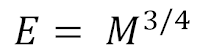
Kleiber's law ( ) is one of those “laws” of nature that is both derived from, and seems to fit quite well with, empirical data. It applies to most animals, including humans. The law is roughly summarized through the equation below, where E = energy expenditure at rest per day, and M = body weight in kilograms. Because of various assumptions made in the original formulation of the law, the values of E do not translate very well to calories as measured today. What is important is the exponent, and what it means in terms of relative increases in weight. Since the exponent in the equation is 3/4, which is lower than 1, the law essentially states that as body weight increases animals become more efficient from an energy expenditure perspective . For example, the energy expenditure at rest of an elephant, per unit of body weight, is significantly lower than that of a mouse. The difference in weight does not have to be as large as that between an elephant and a mouse for a clear differ...

Fasting for 24 hours and ending up with a bigger waist!? This may be a sign that you are losing abdominal fat

Image
This is such a common phenomenon that you’d expect to see it discussed more often – people fasting for a non-negligible number of hours and ending up with a bigger waist. However, it is very difficult to find anything published on it. (Lyle McDonald discussed a related phenomenon on this post on whooshes and squishy fat .) I am not talking about only a perceived bigger waist; I am talking about measurably bigger. This frequently happens with folks who were obese, lost a lot of body fat, and are trying to get rid of the stubborn lower abdominal fat. (Source [ironically]: Gograins.com.au) Fasting and ending up with a bigger waist; how is that possible? Contrary to popular belief, this is very unlikely to be due to the body turning muscle protein into glucose, and then converting that glucose into fat for storage in fat cells around the waist. When you are fasting, one factor strongly opposes that transformation. The body is in net body fat release mode, due in part to low circulating ins...

How lean should one be?

Image
Loss of muscle mass is associated with aging. It is also associated with the metabolic syndrome, together with excessive body fat gain. It is safe to assume that having low muscle and high fat mass, at the same time, is undesirable. The extreme opposite of that, achievable though natural means, would be to have as much muscle as possible and as low body fat as possible. People who achieve that extreme often look a bit like “buff skeletons”. This post assumes that increasing muscle mass through strength training and proper nutrition is healthy. It looks into body fat levels, specifically how low body fat would have to be for health to be maximized. I am happy to acknowledge that quite often I am working on other things and then become interested in a topic that is brought up by Richard Nikoley , and discussed by his readers (I am one of them). This post is a good example of that. Obesity and the diseases of civilization Obesity is strongly associated with the diseases of civilization, o...

How to lose fat and gain muscle at the same time? Strength training plus a mild caloric deficit

Image
Ballor et al. (1996) conducted a classic and interesting study on body composition changes induced by aerobic and strength training. This study gets cited a lot, but apparently for the wrong reasons. One of these reasons can be gleaned from this sentence in the abstract:     “ During the exercise training period, the aerobic training group … had a significant … reduction in body weight … as compared with the [strength] training group ... ” That is, one of the key conclusions of this study was that aerobic training was more effective than strength training as far as weight loss is concerned. (The authors refer to the strength training group as the “weight training group”.) Prior to starting the exercise programs, the 18 participants had lost a significant amount of weight through dieting, for a period of 11 weeks. The authors do not provide details on the diet, other than that it was based on “healthy” food choices. What this means exactly I am not sure, but my guess is th...