Posts

Showing posts with the label tumor necrosis factor-alpha

Hormonal reductionism is as myopic as biochemical reductionism

Image
Biochemistry-based arguments can be very misleading. Yet, biochemistry can be extremely useful in the elucidation of diet and lifestyle effects that are suggested by well-designed studies of humans. If you start with a biochemistry-based argument though, and ignore actual studies of humans, you can easily convince someone that glycogen-depleting exercise (e.g., weight training) is unhealthy, because many health markers change for the worse after that type of exercise. But it is the damage caused by glycogen-depleting exercise that leads to health improvements, via short- and long-term compensatory adaptations ( ). Biochemistry is very helpful in terms of providing “pieces for the puzzle”, but biochemical reductionism is a problem. Analogous to biochemical reductionism, and perhaps one example of it, is hormonal reductionism – trying to argue that all diet and lifestyle effects are mediated by a single hormone. A less extreme position, but still myopic, is to argue that all diet and lif...

Refined carbohydrate-rich foods, palatability, glycemic load, and the Paleo movement

Image
A great deal of discussion has been going on recently revolving around the so-called “carbohydrate hypothesis of obesity”. I will use the acronym CHO to refer to this hypothesis. This acronym is often used to refer to carbohydrates in nutrition research; I hope this will not cause confusion. The CHO could be summarized as this: a person consumes foods with “easily digestible” carbohydrates, those carbohydrates raise insulin levels abnormally, the abnormally high insulin levels drive too much fat into body fat cells and keep it there, this causes hunger as not enough fat is released from fat cells for use as energy, this hunger drives the consumption of more foods with “easily digestible” carbohydrates, and so on. It is posited as a feedback-loop process that causes serious problems over a period of years. The term “easily digestible” is within quotes for emphasis. If it is taken to mean “refined”, which is still a bit vague, there is a good amount of epidemiological evidence in support...

There is no doubt that abnormally elevated insulin is associated with body fat accumulation

Image
For as long as diets existed there have been influential proponents, or believers, who at some point had what they thought were epiphanies. From that point forward, they disavowed the diets that they formally endorsed. Low carbohydrate dieting seems to be in this situation now. Among other things, it has been recently “discovered” that the idea that insulin drives fat into body fat cells is “wrong”. Based on some of the comments I have been receiving lately, apparently a few readers think that I am one of those “enlightened”. If you are interested in what I have been eating, for quite some time now, just click on the link at the top of this blog that refers to my transformation. It is essentially high in all macronutrients on days that I exercise, and low in carbohydrates and calories on days that I don’t. It is a cyclic approach that works for me; calorie surpluses on some days and calorie deficits on other days. But let me set the record straight regarding what I think: there is no ...

Subcutaneous versus visceral fat: How to tell the difference?

Image
The photos below, from Wikipedia, show two patterns of abdominal fat deposition. The one on the left is predominantly of subcutaneous abdominal fat deposition. The one on the right is an example of visceral abdominal fat deposition, around internal organs, together with a significant amount of subcutaneous fat deposition as well. Body fat is not an inert mass used only to store energy. Body fat can be seen as a “distributed organ”, as it secretes a number of hormones into the bloodstream . For example, it secretes leptin, which regulates hunger. It secretes adiponectin , which has many health-promoting properties. It also secretes tumor necrosis factor-alpha (more recently referred to as simply “tumor necrosis factor” in the medical literature), which promotes inflammation. Inflammation is necessary to repair damaged tissue and deal with pathogens, but too much of it does more harm than good. How does one differentiate subcutaneous from visceral abdominal fat? Subcutaneous abdominal f...

Body mass index and cancer deaths in various US states

Image
Ancel Keys is often heavily criticized for allegedly originating the fat phobia that we see today in the US and other countries, perhaps with good reason. But he has also made many important contributions to the health sciences. One of them was the index known as body mass index (BMI), calculated based on a person's weight and height. Unlike other measures, such as body fat percentage and body fat mass, BMI is very easy to calculate; divide your weight (kg) by your height (m) squared. BMI is strongly correlated with body fat percentage, and body fat mass. Very muscular people are exceptions; they may have a high BMI and yet reduced body fat. Excessive body fat mass leads to chronic inflammation, due in part to elevated circulating levels of pro-inflammatory hormones such as tumor necrosis factor-alpha (cute name eh?). Chronic inflammation, in turn, leads to increased incidence of cancer. Thus it should be no surprise that having a BMI above 30 (obesity level) is strongly correlated...

Adiponectin and tumor necrosis factor-alpha levels after a high saturated fat meal

Image
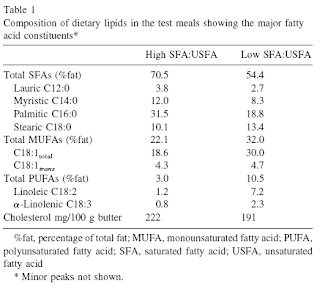
This is one of those interesting studies where the authors start with some pre-conceived assumptions and end up concluding something else, some way toward the opposite of what they assumed. My final interpretation of the study results is a bit different though. It suggests that the results are actually the opposite of what the authors originally assumed. The authors of the study (Poppitt et al., 2008; full reference at the end of this post) start by stating that since “… dietary fat is associated with increased lipid storage, weight gain, and obesity …” it is important to study the effect of dietary fat intake on the blood levels of certain substances that are associated with lipid disorders, weight gain and obesity. In short, the authors start from the assumption that dietary fat is bad. By the way, this type of indictment of all fats is not very common these days. Usually saturated fat is the target. Since dietary fat is assumed to be bad for us, that justifies the authors’ goal of s...