Posts

Showing posts with the label inflammation

Alcohol intake increases LDL cholesterol, in some people

Image
Occasionally I get emails from people experiencing odd fluctuations in health markers, and trying to figure out what is causing those fluctuations. Spikes in LDL cholesterol without any change in diet seem to be a common occurrence, especially in men. LDL cholesterol is a reflection of many things. It is one of the least useful measures in standard lipid profiles, as a predictor of future health problems. Nevertheless, if one’s diet is not changing, whether it is high or low in fat, significant fluctuations in LDL cholesterol may signal a change in inflammatory status. Generally speaking, the more systemic inflammation, the higher is the measured LDL cholesterol. Corella and colleagues (2001) looked into alcohol consumption and its effect on LDL cholesterol, as part of the Framingham Offspring Study. They split the data into three genotypes, which are allele combinations. Alleles are genes variations; that is, they are variations in the sections of DNA that have been identified as cod...

Low omega-6 to omega-3 ratio: Grain-fed meats or industrial vegetable oils?

Image
Just a little note on the use of language. Clearly there is no such a thing as grain-fed or grass-fed beef, because one does not feed beef anything. One feeds cattle grain or grass, and then the resulting beef is said to be “grain-fed” or “grass-fed”. It is a manner of speaking that facilitates discourse, which is why it is used here. To compensate for this digression, let me show you a graph, which pretty much summarizes the "punch line" of this post. The graph below shows the omega-6 fat contents of 1 lb (454 g) of grain-fed beef and 1 tablespoon (roughly 14 g) of a typical industrial vegetable oil (safflower oil). As you can see, there is a lot more omega-6 in the much smaller amount of industrial vegetable oil. A gram-for-gram comparison would practically make the beef content bar disappear. It has been estimated that our Paleolithic ancestors consumed a diet with an omega-6 to omega-3 ratio of about 1 . While other estimates exist, the general consensus seems to be that ...

Adiponectin and tumor necrosis factor-alpha levels after a high saturated fat meal

Image
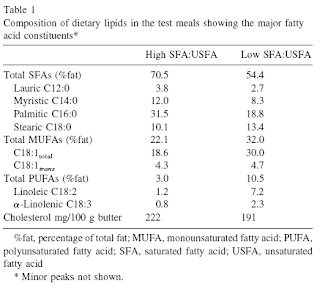
This is one of those interesting studies where the authors start with some pre-conceived assumptions and end up concluding something else, some way toward the opposite of what they assumed. My final interpretation of the study results is a bit different though. It suggests that the results are actually the opposite of what the authors originally assumed. The authors of the study (Poppitt et al., 2008; full reference at the end of this post) start by stating that since “… dietary fat is associated with increased lipid storage, weight gain, and obesity …” it is important to study the effect of dietary fat intake on the blood levels of certain substances that are associated with lipid disorders, weight gain and obesity. In short, the authors start from the assumption that dietary fat is bad. By the way, this type of indictment of all fats is not very common these days. Usually saturated fat is the target. Since dietary fat is assumed to be bad for us, that justifies the authors’ goal of s...

Adiponectin, inflammation, diabetes, and heart disease

Image
Humans, like many animals, evolved to be episodic eaters and spend most of their time fasting. Body fat is the main store of energy in the human body. Excess dietary carbohydrates and fat are stored as body fat, in specialized cells known as adipocytes. Excess dietary protein is not normally stored as body fat . Adipocytes can be seen as being part of a very important and distributed endocrine organ, being responsible for the release of many different hormones into the bloodstream. One of these hormones is adiponectin. Other important hormones secreted by body fat tissue are leptin and tumor necrosis factor-alpha. Among hormones, adiponectin is particularly interesting because it is negatively correlated with body fat mass. That is, unlike other hormones such as leptin and tumor necrosis factor-alpha, a decrease in body fat mass (a well known health marker) is associated with an increase in adiponectin. This has led some researchers to speculate that adiponectin is a causative factor t...

Body fat and disease: How much body fat can I lose in one day?

Image
Body fat is not an inert deposit of energy. It can be seen as a distributed endocrine organ. Body fat cells, or adipocytes, secrete a number of different hormones into the bloodstream. Major hormones secreted by adipose tissue are adiponectin and leptin. Estrogen is also secreted by body fat, which is one of the reasons why obesity is associated with infertility. (Yes, abnormally high levels of estrogen can reduce fertility in both men and women.) Moreover, body fat secretes tumor necrosis factor-alpha, a hormone that is associated with generalized inflammation and a number of diseases, including cancer, when in excess. The reduction in circulating tumor necrosis factor-alpha and other pro-inflammatory hormones as one loses weight is one reason why non-obese people usually experience fewer illness symptoms than those who are obese in any given year, other things being equal. For example, the non-obese will have fewer illness episodes that require full rest during the flu season. In tho...

Intermittent fasting and reduced inflammation

A recent post  on the Primal Wisdom blog led me to do go back to some of the research on an approach to dieting that I tried myself, with some positive results. The approach is known as intermittent fasting (IF). I also found an excellent blog post by Dr. Michael Eades on IF (see  here ). Typically IF involves fasting every other day. On the non-fasting days, food and water consumption is not restricted in any way. On fasting days, only water is consumed. Variations of this approach usually involve replacing water with juice, and having an eating window of only a few hours within longer periods – e.g., fasting 19 hours and then eating during a window of 5 hours, for each period of 24 hours. IF is different from calorie restriction (CR), in that in the latter total daily calorie intake is restricted to a somewhat fixed amount, below one’s basal metabolic rate (the number of calories needed to maintain one’s current weight). In CR the calorie restriction is not normally ach...