Posts

Showing posts with the label recipe

Dried meat: Homemade beef jerky

Image
You can dry many types of meat, including beef, pork, goat, deer, and even some types of seafood, such as mussels. Drying meat tends to significantly increase the meat’s protein content per gram, often more than doubling it. It also helps preserve the meat, as bacteria need an aqueous environment to grow; adding salt helps further prevent bacterial growth. Dried meat preparation and consumption was common among the Plains Indians (e.g., of the Cheyenne, Comanche, and Lakota tribes), and also a valuable trade item for them. They often ground the dried meat into a powder, mixing fat and berries with them; the result of which was pemmican. Many other hunter-gatherer cultures around the world have incorporated dried meat into their diets. Below is a recipe for homemade beef jerky, which is very close in terms of nutrition content to the dried meat of the Plains Indians's time; that is, the time when the Plains Indians subsisted mostly on bison. Commercial beef jerky typically has a...

How to make white rice nutritious

Image
One of the problems often pointed out about rice, and particularly about white rice, is that its nutrition content is fairly low. It is basically carbohydrates with some trace amounts of protein. A 100-g portion of cooked white rice will typically deliver 28 g of carbohydrates, with zero fiber, and 3 g of protein. The micronutrient content of such a portion leaves a lot to be desired when compared with fruits and vegetables, as you can see below (from Nutritiondata.com). Keep in mind that this is for 100 g of “enriched” white rice; the nutrients you see there, such as manganese, are added. White rice is rice that has had its husk, bran, and germ removed. This prevents spoilage and thus significantly increases its shelf life. As it happens, it also significantly reduces both its nutrition and toxin content. White rice is one of the refined foods with the lowest toxin content. Another interesting property of white rice is that it absorbs moisture to the tune of about 2.5 times its weig...

Ground meat treats: Beef and bison meatza

Image
At the time of this writing, there was no Wikipedia article for the term “meatza”, which surprised me a bit given the number of recipes on the web. In fact, I could not find anything concrete about the dish’s tradition or  history. Another thing that surprised me about this dish is how much my family and I like it. It has become a regular weekend treat for us for quite some time now. The recipe below is for a meal that feeds 4-8 people. Like in my previous recipe for a zucchini and onion meatloaf ( ), the ground beef used here has little fat, and thus a relatively low omega-6 content. Most of the fat comes from the ground bison, which has a higher omega-3 to omega-6 ratio. - Prepare some dry seasoning powder by mixing sea salt, parsley flakes, garlic powder, chili powder, and a small amount of cayenne pepper. - Mix 2 lb of very lean ground beef (96/4) with 1 lb of ground bison. - Add the dry seasoning and a whole egg to the ground meat mix. - Vigorously mix by hand until ...

Ground meat treats: Zucchini and onion meatloaf

Image
A cousin of the meatball ( ), the meatloaf is a traditional German dish. The recipe below is for a meal that feeds 4-8 people. The ground beef used has little fat, and thus a relatively low omega-6 content. Most of the fat comes from the 1 lb of ground grass-fed lamb in the recipe, which has a higher omega-3 to omega-6 ratio than the regular (i.e., non-grass-fed) ground beef. The egg acts as a binder. Leave the potato out if you want to decrease the carbohydrate content; it does not add much (nutrient numbers are provided at the end of the post). - Prepare some dry seasoning powder by mixing salt, parsley flakes, garlic powder, chili powder, and a small amount of cayenne pepper. - Grate one zucchini squash and one peeled potato. Cut half an onion into small pieces of similar size. - Mix 2 lb of very lean ground beef (96/4) with 1 lb of ground grass-fed lamb. - Add the dry seasoning, zucchini, potato, onion and a whole egg to the ground meat mix. - Vigorously mix by hand until you get a...

Liver and meatballs separated by a wall of sweet potatoes

Image
A commenter wrote here some time ago that she liked to eat rice because rice can be easily used to separate food items on a plate. One can just as easily use sweet potatoes to do that; preparing the sweet potatoes in much less time than the rice. This post explains how, with a simple recipe. - Cut up half of a sweet potato as shown on the first photo below, adding coconut oil or butter to prevent the pieces from sticking to a microwave-safe saucepan. - Microwave the sweet potato pieces in high heat for about 5 minutes. - Use the sweet potatoes to separate food items as in the second photo below, showing beef liver and meatballs with their respective sauces. - Cover the dish with a wet paper towel to prevent spilling, and microwave it for as long as needed to heat up the meats. In this case, 2 minutes in high heat was enough. That will further cook the sweet potato, but not to the point of burning it. The above assumes that the beef liver and meatballs are leftovers that had been cooked...

Beef meatballs, with no spaghetti

Image
There are pizza restaurants, whose specialty is pizza, even though they usually have a few side dishes. Not healthy enough? Well, don’t despair, there are meatball restaurants too. I know of at least one, The Meatball Shop , on 84 Stanton Street, in New York City. Finally a restaurant that elevates the "lowly" meatball to its well deserved place! Meatballs are delicious, easy to prepare, and you can use quite a variety of meats to do them. Below is a simple recipe. We used ground grass-fed beef, not because of omega-6 concerns (see this post ), but because of the different taste. - Prepare some dry seasoning powder by mixing sea salt, parsley, garlic power, chili powder, and a small amount of cayenne pepper. - Thoroughly mix 1 pound of ground beef, one or two eggs, and the seasoning powder. - Make about 10 meatballs, and place them in a frying pan with a small amount of water (see picture below). - Cover the pan and cook on low fire for about 1 hour. There is no need for any ...

Pressure-cooked meat: Top sirloin

Image
Pressure cooking relies on physics to take advantage of the high temperatures of liquids and vapors in a sealed container. The sealed container is the pressure-cooking pan. Since the sealed container does not allow liquids or vapors to escape, the pressure inside the container increases as heat is applied to the pan. This also significantly increases the temperature of the liquids and vapors inside the container, which speeds up cooking. Pressure cooking is essentially a version of high-heat steaming. The food inside the cooker tends to be very evenly cooked. Pressure cooking is also considered to be one of the most effective cooking methods for killing food-born pathogens. Since high pressure reduces cooking time, pressure cooking is usually employed in industrial food processing. When cooking meat, the amount of pressure used tends to affect amino-acid digestibility; more pressure decreases digestibility. High pressures in the cooker cause high temperatures. The content of some vitam...

Slow-cooked meat: Round steak, not grilled, but slow-cooked in a frying pan

Image
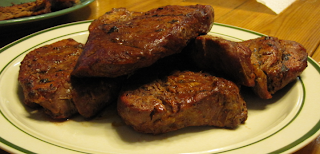
I am yet to be convinced that grilled meat is truly unhealthy in the absence of leaky gut problems. I am referring here to high heat cooking-induced Maillard reactions and the resulting advanced glycation endproducts (AGEs). If you are interested, see this post and the comments under it, where I looked into some references provided by an anonymous commenter. In short, I am more concerned about endogenous (i.e., inside the body) formation of AGEs than with exogenous (e.g., dietary) intake. Still, the other day I had to improvise when cooking meat, and used a cooking method that is considered by many to be fairly healthy – slow-cooking at a low temperature. I seasoned a few pieces of beef tenderloin (filet mignon) for the grill, but it started raining, so I decided to slow-cook them in a frying pan with water and some olive oil. After about 1 hour of slow-cooking, and somewhat to my surprise, they tasted more delicious than grilled! I have since been using this method more and more, wit...

What about some offal? Boiled tripes in tomato sauce

Image
Tripe dishes are made with the stomach of various ruminants. The most common type of tripe is beef tripe from cattle. Like many predators, our Paleolithic ancestors probably ate plenty of offal, likely including tripe. They certainly did not eat only muscle meat. It would have been a big waste to eat only muscle meat, particularly because animal organs and other non-muscle parts are very rich in vitamins and minerals. The taste for tripe is an acquired one. Many national cuisines have traditional tripe dishes, including the French, Chinese, Portuguese, and Mexican cuisines – to name only a few. The tripe dish shown in the photo below was prepared following a simple recipe. Click on the photo to enlarge it. Here is the recipe: - Cut up about 2 lbs of tripe into rectangular strips. I suggest rectangles of about 5 by 1 inches. - Boil the tripe strips in low heat for 5 hours. - Drain the boiled tripe strips, and place them in a frying or sauce pan. You may use the same pan you used for boi...

Oven roasted meat: Pork tenderloin

Image
This cut of pork is the equivalent in the pig of the filet mignon in cattle. It is just as soft, and lean too. A 100 g portion of roasted pork tenderloin will have about 22 g of protein, and 6 g of fat. Most of the fat will be monounsaturated and saturated, and some polyunsaturated. The latter will contain about 450 mg of omega-6 and 15 mg of omega-3 fats in it. The saturated fat is good for you. The omega-6-to-omega-3 ratio is not a great one, but a 100 g portion will have a small absolute amount of omega-6 fats, which can be easily offset with some omega-3 from seafood or a small amount of fish oil. Pork tenderloin is easy to find in supermarkets, and is much less expensive than filet mignon, even though it is a relatively expensive cut of meat. Below are the before and after photos of a roasted pork tenderloin we prepared and ate recently; a simple recipe follows the photos. This type of cooking leads to a Maillard reaction , which is clear from the browning of the meat and around ...

Tender cuts of meat for the grill: Filet mignon and bison

Image
Filet mignon is one of the tenderest cuts of beef. It is also one of my favorites. Filet mignon comes from the tenderloin area (see this picture ), which is not a weight-bearing area and thus is very tender. The bison cuts I get here in South Texas are close in terms of tenderness, but not as tender, probably because they are from the round area. One steak of either filet mignon or bison will yield about 100 g of cooked meat, with 30 g of protein and 10 g of fat. About half of that fat will be saturated and half monounsaturated (as in olive oil). It will provide you with plenty of vitamins (particular B vitamins) and minerals. Good amounts of selenium, phosphorus, zinc and potassium. On the photo below (click on it to enlarge), the bison steak is at the top. The other pieces are all filet mignon cuts. They are all medium-cooked. I cooked two plates of these, for 6 people. All ate to satisfaction, with a side salad. The leftovers are delicious for breakfast in small amounts. For the fil...

Steamed gulf shrimp with vegetables

Image
Few would argue against eating seafood several times a week, except in the case of seafood allergy. Shrimp is a very good option, especially if it is not farm raised. 100 g of shrimp will typically have 20 g of protein, and about 152 mg of cholesterol (this is good for your health ). It will also have about 0.6 g of omega-3 fats, and 0.03 g of omega-6; an omega-3 to omega-6 ratio of about 20. My wife prepared this steamed gulf shrimp with vegetables dish. And it was very, very delicious. Here is her recipe: - Add a small amount of olive oil and water to a frying pan. - Add 1 lb of wild-caught peeled gulf shrimp, cabbage, onion, and asparagus (or green beans, as in the photo). - Cook in low heat for 15 minutes. - Add spinach and cook in low heat for another 10 minutes. - Turn off heat, season to taste while mixing; I suggest using garlic powder, cumin powder, and parsley flakes. Peeled shrimp is usually farm raised, which does not have the same amount of omega-3, or the same ratio of om...

How to break a coconut

Image
The coconut is often presented as a healthy food choice, which it is, as long as you are not allergic to it. Coconut meat has a lot of saturated fat, which is very good for the vast majority of us. (I posted about this issue elsewhere on this blog: my own experience and research suggest that saturated fat is very healthy for most people as long as it is NOT consumed together with refined carbs and sugars from industrialized food products.) Coconut water is a good source of essential minerals, particularly magnesium and potassium. So is coconut meat, which is rich in iron, copper, manganese, and selenium. Coconut meat is also an good source of folate and an excellent source of dietary fiber. If you are buying coconuts at a supermarket, I suggest choosing coconuts that have a lot of water in them. They seem to be the ones that taste the best. Just pick a coconut up and shake it. If it feels heavy and full of water, that’s the one. First you need to make some holes on the coconut...

Eating fish whole: Sardines

Image
Different parts of a fish have different types of nutrients that are important for our health; this includes bones and organs. Therefore it makes sense to consume the fish whole, not just filets made from it. This is easier to do with small than big fish. Small fish have the added advantage that they have very low concentrations of metals, compared to large fish. The reason for this is that small fish are usually low in the food chain, typically feeding mostly on plankton, especially algae. Large carnivorous fish tend to accumulate metals in their body, and their consumption over time may lead to the accumulation of toxic levels of metals in our bodies. One of my favorite types of small fish is the sardine. The photo below is of a dish of sardines and vegetables that I prepared recently. Another small fish favorite is the smelt (see this post ). I buy wild-caught sardines regularly at the supermarket. Sardines are very affordable, and typically available throughout the year. In fact, s...

Eating fish whole: Smelts

Image
Since different parts of a fish have different types of nutrients that are important for our health, it makes sense to consume the fish whole. This is easier to do with small than big fish. One of my favorite types of small fish is the smelt; the photo below shows a batch of smelts that I prepared using the recipe below. Another small fish favorite is the sardine. Small fish are usually low in the food chain, and thus have very low concentrations of metals that can be toxic to humans. Many people dislike the taste of smelts, but will eat them if they are well seasoned and their texture is somewhat hard. Here is a recipe that will get you that. - Steam cook the smelts for 30 minutes to 1 hour (less time = harder texture). - Spread the steam cooked smelts on a sheet pan covered with aluminum foil; use light olive oil to prevent the fish from sticking to the foil. - Preheat oven to 350 degrees Fahrenheit. - Season the steam cooked smelts to taste; I suggest using salt, chili powder, garli...