Posts

Showing posts with the label low carb

Dried meat: Homemade beef jerky

Image
You can dry many types of meat, including beef, pork, goat, deer, and even some types of seafood, such as mussels. Drying meat tends to significantly increase the meat’s protein content per gram, often more than doubling it. It also helps preserve the meat, as bacteria need an aqueous environment to grow; adding salt helps further prevent bacterial growth. Dried meat preparation and consumption was common among the Plains Indians (e.g., of the Cheyenne, Comanche, and Lakota tribes), and also a valuable trade item for them. They often ground the dried meat into a powder, mixing fat and berries with them; the result of which was pemmican. Many other hunter-gatherer cultures around the world have incorporated dried meat into their diets. Below is a recipe for homemade beef jerky, which is very close in terms of nutrition content to the dried meat of the Plains Indians's time; that is, the time when the Plains Indians subsisted mostly on bison. Commercial beef jerky typically has a...
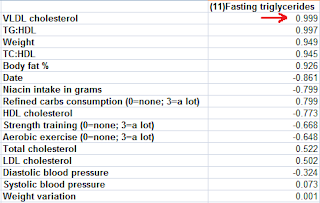
Triglycerides, VLDL, and industrial carbohydrate-rich foods

Image
Below are the coefficients of association calculated by HealthCorrelator for Excel (HCE) for user John Doe. The coefficients of association are calculated as linear correlations in HCE ( ). The focus here is on the associations between fasting triglycerides and various other variables. Take a look at the coefficient of association at the top, with VLDL cholesterol, indicated with a red arrow. It is a very high 0.999. Whoa! What is this – 0.999! Is John Doe a unique case? No, this strong association between fasting triglycerides and VLDL cholesterol is a very common pattern among HCE users. The reason is simple. VLDL cholesterol is not normally measured directly, but typically calculated based on fasting triglycerides, by dividing the fasting triglycerides measurement by 5. And there is an underlying reason for that - fasting triglycerides and VLDL cholesterol are actually very highly correlated, based on direct measurements of these two variables. But if VLDL cholesterol is calcula...

Book review: Perfect Health Diet

Image
Perfect Health Diet is a book that one should own. It is not the type of book that you can get from your local library and just do a quick read over (and, maybe, write a review about it). If you do that, you will probably miss several important ideas that form the foundation of this book, which is a deep foundation. The book is titled “Perfect Health Diet”, not “The Perfect Health Diet”. If you think that this is a mistake, consider that the most successful social networking web site of all time started as “The Facebook”, and then changed to simply “Facebook”; which was perceived later as a major improvement. Moreover, “Perfect Health Diet” makes for a cool and not at all inappropriate acronym – “PHD”. What people eat has an enormous influence on their lives, and also on the lives of those around them. Nutrition is clearly one of the most important topics in the modern world - it is the source of much happiness and suffering for entire populations. If Albert Einstein and Marie Curie w...

Potassium deficiency in low carbohydrate dieting: High protein and fat alternatives that do not involve supplementation

It is often pointed out, at least anecdotally, that potassium deficiency is common among low carbohydrate dieters. Potassium deficiency can lead to a number of unpleasant symptoms and health problems. This micronutrient is present in small quantities in meat and seafood; main sources are plant foods. A while ago this has gotten me thinking and asking myself: what about isolated hunter-gatherers that seem to have thrived consuming mostly carnivorous diets with little potassium, such as various Native American tribes? Another thought came to mind, which is that animal protein seems to be associated with increased bone mineralization, even when calcium intake is low . That seems to be due to animal protein being associated with increased absorption of calcium and other minerals that make up bone tissue. Maybe animal protein intake is also associated with increased potassium absorption . If this is true, what could be the possible mechanism? As it turns out, there is one possible and somew...

Dietary protein does not become body fat if you are on a low carbohydrate diet

By definition LC is about dietary carbohydrate restriction. If you are reducing carbohydrates, your proportional intake of protein or fat, or both, will go up. While I don’t think there is anything wrong with a high fat diet, it seems to me that the true advantage of LC may be in how protein is allocated, which seems to contribute to a better body composition. LC with more animal protein and less fat makes particularly good sense to me. Eating a variety of unprocessed animal foods, as opposed to only muscle meat from grain-fed cattle, will get you that. In simple terms, LC with more protein, achieved in a natural way with unprocessed foods, means more of the following in one's diet: lean meats, seafood and vegetables. Possibly with lean meats and seafood making up more than half of one’s protein intake. Generally speaking, large predatory fish species (e.g., various shark species, including dogfish) are better avoided to reduce exposure to toxic metals. Organ meats such as beef liv...

What is a good low carbohydrate diet? It is a low calorie one

My interview with Jimmy Moore should be up on the day that this post becomes available. (I usually write my posts on weekends and schedule them for release at the beginning of the following weeks.) So the time is opportune for me to try to aswer this question: What is a good low carbohydrate diet? For me, and many people I know, the answer is: a low calorie one. What this means, in simple terms, is that a good low carbohydrate diet is one with plenty of seafood and organ meats in it, and also plenty of veggies. These are low carbohydrate foods that are also naturally low in calories. Conversely, a low carbohydrate diet of mostly beef and eggs would be a high calorie one. Seafood and organ meats provide essential fatty acids and are typically packed with nutrients. Because of that, they tend to be satiating. In fact, certain organ meats, such as beef liver, are so packed with nutrients that it is a good idea to limit their consumption. I suggest eating beef liver once or twice a we...

Ketones and Ketosis: Physiological and pathological forms

Image
Ketones are compounds that have a specific chemical structure. The figure below (from: Wikipedia) shows the chemical structure of various types of ketones. As you can see, all ketones share a carbonyl group; that is the “O=” part of their chemical structure. A carbonyl group is an oxygen atom double-bonded to a carbon atom. Technically speaking, many substances can be classified as ketones. Not all of these are involved in the same metabolic processes in humans. For example, fructose is technically a ketone, but it is not one of the three main ketones produced by humans from dietary macronutrients (discussed below), and is not metabolized in the same way as are those three main ketones. Humans, as well as most other vertebrates, produce three main ketones (also known as ketone bodies) from dietary macronutrients. These are acetone, acetoacetate and beta-hydroxybutyrate. Low carbohydrate diets tend to promote glycogen depletion, which in turn leads to increased production of th...

Long-term adherence to Dr. Kwaśniewski’s Optimal Diet: Healthy with high LDL cholesterol

Image
This is a study (Grieb, P. et al., 2008; full reference at the end of this post) that I read a few years ago, right after it came out, and at the time I recall thinking about the apparent contradiction between the positive effects of the Optimal Diet and the very elevated LDL cholesterol levels among the participants. I say “contradiction” because of the established and misguided dogma among medical doctors, particularly general practitioners, that decreasing LDL cholesterol levels is the best strategy to avoid cardiovascular disease. The Optimal Diet is one of the best examples of a healthy diet where LDL cholesterol levels are generally high, in fact much higher than most people are willing to accept as healthy today. (In this study, LDL cholesterol levels were calculated based on the Friedewald equation .) It is not uncommon to see people concerned about their high LDL cholesterol levels after adopting a low carbohydrate diet. (A low carbohydrate diet is, generally speaking, a high ...

Steamed gulf shrimp with vegetables

Image
Few would argue against eating seafood several times a week, except in the case of seafood allergy. Shrimp is a very good option, especially if it is not farm raised. 100 g of shrimp will typically have 20 g of protein, and about 152 mg of cholesterol (this is good for your health ). It will also have about 0.6 g of omega-3 fats, and 0.03 g of omega-6; an omega-3 to omega-6 ratio of about 20. My wife prepared this steamed gulf shrimp with vegetables dish. And it was very, very delicious. Here is her recipe: - Add a small amount of olive oil and water to a frying pan. - Add 1 lb of wild-caught peeled gulf shrimp, cabbage, onion, and asparagus (or green beans, as in the photo). - Cook in low heat for 15 minutes. - Add spinach and cook in low heat for another 10 minutes. - Turn off heat, season to taste while mixing; I suggest using garlic powder, cumin powder, and parsley flakes. Peeled shrimp is usually farm raised, which does not have the same amount of omega-3, or the same ratio of om...

Want to improve your cholesterol profile? Replace refined carbs and sugars with saturated fat and cholesterol in your diet

Image
An interesting study by Clifton and colleagues (1998; full reference and link at the end of this post) looked at whether LDL cholesterol particle size distribution at baseline (i.e., beginning of the study) for various people was a determinant of lipid profile changes in each of two diets – one low and the other high in fat. This study highlights a few interesting points made in a previous post , which are largely unrelated to the main goal or findings of the study, but that are supported by side findings: - As one increases dietary cholesterol and fat consumption, particularly saturated fat, circulating HDL cholesterol increases significantly. This happens whether one is taking niacin or not, although niacin seems to help, possibly as an independent (not moderating) factor. Increasing serum vitamin D levels, which can be done through sunlight exposure and supplementation, are also known to increase circulating HDL cholesterol. - As one increases dietary cholesterol and fat consumption...

Okinawa: The island of pork

The original inhabitants of the Ryūkyū Islands, of which the island of Okinawa is the largest, are believed to have the highest life expectancy in the world. One of the staples of their diet is sweet potatoes. The carbohydrate percentage of a sweet potato is about 20; that is, each 100 g of sweet potato mass has about 20 g of carbohydrates. Sweet potatoes have a medium-high glycemic index, and are often avoided by those with impaired insulin sensitivity, and certainly by diabetics. The other main staple of their diet is pork, as you may have inferred from the title of this post. The quote below is from the first of the three links provided below the quote. Pork appears so frequently in the Okinawan diet that to say "meat" is really to say "pork." [...] It is no exaggeration to say that the present-day Okinawan diet begins and ends with pork.          http://www.wonder-okinawa.jp/026/e/pork.html          http://www.okinawaindex.com...

Half-hearted Atkins diet and cardiovascular disease

I would like to comment on a recent  article comparing the Atkins, Ornish and South Beach diets (Miller et al., 2009; full reference at the end of this posting), which has been causing quite a lot of commotion among bloggers recently. Especially low carb. bloggers. An excellent post by Michael Eades clarifies a number of issues with the study, including what one could argue is the study's main flaw. Apparently the study compared a half-hearted Atkins diet, with probably equally half-hearted Ornish and  South   Beach  diets. I refer to the study's Atkins diet as half-hearted because it seems to rely on a daily consumption of between 120 and 180 grams of carbohydrates. This is unlikely to lead to ketosis, the cornerstone of the Atkins diet, where the body uses ketone bodies (made from dietary as well as body fat) as a source of energy. As I see it, the main findings of the study were that the participants in the half-hearted Atkins diet, after a period of 4 we...