Posts

Showing posts with the label saturated fat

The 2012 Atherosclerosis egg study: Plaque decreased as LDL increased with consumption of 2.3 eggs per week or more

Image
A new study by David Spence and colleagues, published online in July 2012 in the journal Atherosclerosis ( ), has been gaining increasing media attention (e.g., ). The article is titled: “Egg yolk consumption and carotid plaque”. As the title implies, the study focuses on egg yolk consumption and its association with carotid artery plaque buildup. The study argues that “regular consumption of egg yolk should be avoided by persons at risk of cardiovascular disease”. It hints at egg yolks being unhealthy in general, possibly even more so than cigarettes. Solid critiques have already been posted on blogs by Mark Sisson, Chris Masterjohn, and Zoe Harcombe ( , , ), among others. These critiques present valid arguments for why the key findings of the study cannot be accepted, especially the finding that eggs are more dangerous to one’s health than cigarettes. This post is a bit different. It uses the data reported in the study to show that it (the data) suggests that egg consumption is act...

Nuts by numbers: Should you eat them, and how much?

Image
Nuts are generally seen as good sources of protein and magnesium. The latter plays a number of roles in the human body, and is considered critical for bone health. Nuts are also believed to be good sources of vitamin E. While there is a lot of debate about vitamin E’s role in health, it is considered by many to be a powerful antioxidant. Other than in nuts, vitamin E is not easily found in foods other than seeds and seed oils. Some of the foods that we call nuts are actually seeds; others are legumes. For simplification, in this post I am calling nuts those foods that are generally protected by shells (some harder than others). This protective layer is what makes most people call them nuts. Let us see how different nuts stack up against each other in terms of key nutrients. The quantities listed below are per 1 oz (28 g), and are based on data from Nutritiondata.com. All are raw. Roasting tends to reduce the vitamin content of nuts, often by half, and has little effect on the mineral c...

Long-term adherence to Dr. Kwaśniewski’s Optimal Diet: Healthy with high LDL cholesterol

Image
This is a study (Grieb, P. et al., 2008; full reference at the end of this post) that I read a few years ago, right after it came out, and at the time I recall thinking about the apparent contradiction between the positive effects of the Optimal Diet and the very elevated LDL cholesterol levels among the participants. I say “contradiction” because of the established and misguided dogma among medical doctors, particularly general practitioners, that decreasing LDL cholesterol levels is the best strategy to avoid cardiovascular disease. The Optimal Diet is one of the best examples of a healthy diet where LDL cholesterol levels are generally high, in fact much higher than most people are willing to accept as healthy today. (In this study, LDL cholesterol levels were calculated based on the Friedewald equation .) It is not uncommon to see people concerned about their high LDL cholesterol levels after adopting a low carbohydrate diet. (A low carbohydrate diet is, generally speaking, a high ...

More on the Harvard study on saturated versus polyunsaturated fats

This is a follow up on this post , which addressed the main argument put forth in a recent BBC article. The BBC article argued that people should replace saturated with polyunsaturated fats to reduce their risk of heart disease. Let us take a look at the actual Harvard study itself (i.e., the study discussed in the BBC article). The Harvard study is linked here . This post , by Stephan Guyenet, already pointed out several problems with the study. Stephan actually reviewed the studies used in the meta-analysis, and also some that were excluded in the meta-analysis and that he believes should have been included. Here are a few other problems, in addition to the ones already pointed out by Stephan: One thing that looks suspicious about this Harvard meta-analysis study is that they say that: “Statistical evidence for substantial between-study heterogeneity was not present (Q-statistic p = 0.13; I2 = 37%).” A meta-analysis is a study that essentially summarizes, in a statistically sophistic...

BBC article's advice: Replace saturated with polyunsaturated fats

The BBC article is here . It is based on meta-analysis of eight previous studies conducted by Harvard researchers, which the article states cover more than 13,000 people. The article also says that: “… [saturated] fats raise the levels of bad cholesterol that block the arteries to the heart.” They are of course referring to LDL cholesterol as the "bad cholesterol". Sourcing bias is a notorious problem with meta-analyses (i.e., the choice of studies to use in a meta-analysis). Another problem is that you cannot tell what the studies sourced controlled for. Consider a study that compares health markers for smokers and non-smokers, where the smokers eat more saturated fat than the non-smokers. This study may confuse the effect of smoking with that of saturated fat consumption. To be reliable, the study must analyze the effect of saturated fat consumption, controlling for smoking habits. There are other statistical issues to be considered in meta-analyses. For example, some of th...

PepsiCo to reduce sugar and fat in products

I guess PepsiCo is moving ahead of the competition, but in a snail pace and in a very, very politically correct way. Will this help in any way? I doubt. It is just too little, too late. See article here . The article states that: The company also set two goals for the next 10 years: to cut the average added sugar per serving by 25 percent and saturated fat per serving by 15 percent, in addition to adding more whole grains, fruits, vegetables and low-fat dairy into its array of products. While it is nice to see more of a focus on sugar than on saturated fat, I would have preferred to see something like this: The company also set two goals for the next 5 years: to cut the average added sugar per serving by 95 percent and increase saturated fat per serving by 50 percent, in addition to adding more vegetables and full-fat dairy into its array of products. What would happen? Well, Indra Nooyi is a very smart CEO, and the company has many competent people. They know that they would probably ...

Adiponectin and tumor necrosis factor-alpha levels after a high saturated fat meal

Image
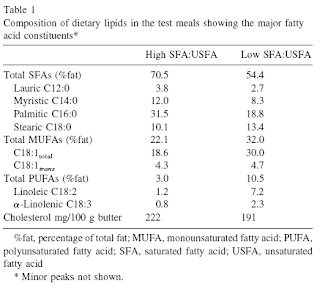
This is one of those interesting studies where the authors start with some pre-conceived assumptions and end up concluding something else, some way toward the opposite of what they assumed. My final interpretation of the study results is a bit different though. It suggests that the results are actually the opposite of what the authors originally assumed. The authors of the study (Poppitt et al., 2008; full reference at the end of this post) start by stating that since “… dietary fat is associated with increased lipid storage, weight gain, and obesity …” it is important to study the effect of dietary fat intake on the blood levels of certain substances that are associated with lipid disorders, weight gain and obesity. In short, the authors start from the assumption that dietary fat is bad. By the way, this type of indictment of all fats is not very common these days. Usually saturated fat is the target. Since dietary fat is assumed to be bad for us, that justifies the authors’ goal of s...

What should be my HDL cholesterol?

Image
HDL cholesterol levels are a rough measure of HDL particle quantity in the blood. They actually tell us next to nothing about HDL particle type, although HDL cholesterol increases are usually associated with increases in LDL particle size. This a good thing, since small-dense LDL particles are associated with increased cardiovascular disease. Most blood lipid panels reviewed by family doctors with patients give information about HDL status through measures of HDL cholesterol, provided in one of the standard units (e.g., mg/dl). Study after study shows that HDL cholesterol levels, although imprecise, are a much better predictor of cardiovascular disease than LDL or total cholesterol levels. How high should be one’s HDL cholesterol? The answer to this question is somewhat dependent on each individual’s health profile, but most data suggest that a level greater than 60  mg/dl (1.55 mmol/l) is close to optimal for most people . The figure below (from Eckardstein, 2008; full refere...

Large LDL and small HDL particles: The best combination

Image
High-density lipoprotein (HDL) is one of the five main types of lipoproteins found in circulation, together with very low-density lipoprotein (VLDL), intermediate-density lipoprotein (IDL), low-density lipoprotein (LDL), and chylomicrons. After a fatty meal, the blood is filled with chylomicrons, which carry triglycerides (TGAs). The TGAs are transferred to cells from chylomicrons via the activity of enzymes, in the form of free fatty acids (FFAs), which are used by those cells as sources of energy. After delivering FFAs to the cells, the chylomicrons progressively lose their TGA content and “shrink”, eventually being absorbed and recycled by the liver. The liver exports part of the TGAs that it gets from chylomicrons back to cells for use as energy as well, now in the form of VLDL. As VLDL particles deliver TGAs to the cells they shrink in size, similarly to chylomicrons. As they shrink, VLDL particles first become IDL and then LDL particles. The figure below (click on it to enlarge),...

How to break a coconut

Image
The coconut is often presented as a healthy food choice, which it is, as long as you are not allergic to it. Coconut meat has a lot of saturated fat, which is very good for the vast majority of us. (I posted about this issue elsewhere on this blog: my own experience and research suggest that saturated fat is very healthy for most people as long as it is NOT consumed together with refined carbs and sugars from industrialized food products.) Coconut water is a good source of essential minerals, particularly magnesium and potassium. So is coconut meat, which is rich in iron, copper, manganese, and selenium. Coconut meat is also an good source of folate and an excellent source of dietary fiber. If you are buying coconuts at a supermarket, I suggest choosing coconuts that have a lot of water in them. They seem to be the ones that taste the best. Just pick a coconut up and shake it. If it feels heavy and full of water, that’s the one. First you need to make some holes on the coconut...

Ischemic heart disease among Greenland Inuit: Data from 1962 to 1964

Image
The traditional Inuit diet is very high in animal protein and fat. It also includes plant matter. Typically it is made up primarily of the following: fish, walrus, seal, whale, berries, and fireweed (of which syrups and jellies can be made). Kjærgaard and colleagues (see under References, at the end of this post) examined data from an Inuit population in Greenland from 1962 to 1964, prior to the heavy westernization of their diet that is seen today. They investigated 96.9% of the whole population in three areas, including Ammassalik in East Greenland (n = 1,851). Of those, only 181 adults, or 9.7 percent, had anything that looked like an abnormality that could suggest ischemia. This included ventricular hypertrophy (an enlargement of the heart chambers), leading to an overestimation because benign ventricular hypertrophy is induced by continuous physical exertion. These 181 adults were then selected for further screening. Benign ventricular hypertrophy is also known as athlete's he...

Saturated fat intake not associated with heart disease – Dr. Cordain’s article

I would like to comment on a recent article co-authored by Dr. Loren Cordain, and published in the journal Current Treatment Options in Cardiovascular Medicine, in 2009. Dr. Cordain is probably the leading expert today on the diet of our Stone Age ancestors. The importance of this article comes from the fact that in the past Dr. Cordain has argued that our Stone Age ancestors have not consumed large amounts of saturated fat, because of the relatively low percentage of fat in the flesh of wild animals. This led, according to Dr. Cordain, to an evolved body design that is not well adapted to the consumption of significant amounts of saturated fat. Yet, many other researchers have argued that saturated fats are beneficial to our health, with ample empirical evidence to back up their statements. The researchers at the Weston A. Price Foundation have been particularly prominent voices in favor of saturate fats. Now, this acknowledgement that saturated fats (or saturated fatty acids) are n...