Posts

Showing posts with the label refined carbs

The 2013 PLoS ONE sugar and diabetes study: Sugar from fruits is harmless

Image
A new study linking sugar consumption with diabetes prevalence has gained significant media attention recently. The study was published in February 2013 in the journal PLoS ONE ( ). The authors are Sanjay Basu, Paula Yoffe, Nancy Hills and Robert H. Lustig. Among the claims made by the media is that “… sugar consumption — independent of obesity — is a major factor behind the recent global pandemic of type 2 diabetes” ( ). As it turns out, the effects revealed by the study seem to be very small, which may actually be a side effect of data aggregation; I will discuss this further below. Fruits are exonerated Let me start by saying that this study also included in the analysis the main natural source of sugar, fruit, as a competing variable (competing with the effects of sugar itself), and found it to be unrelated to diabetes. As the authors note: “None of the other food categories — including fiber-containing foods (pulses, nuts, vegetables, roots, tubers), fruits, meats, cereals, and ...

How to make white rice nutritious

Image
One of the problems often pointed out about rice, and particularly about white rice, is that its nutrition content is fairly low. It is basically carbohydrates with some trace amounts of protein. A 100-g portion of cooked white rice will typically deliver 28 g of carbohydrates, with zero fiber, and 3 g of protein. The micronutrient content of such a portion leaves a lot to be desired when compared with fruits and vegetables, as you can see below (from Nutritiondata.com). Keep in mind that this is for 100 g of “enriched” white rice; the nutrients you see there, such as manganese, are added. White rice is rice that has had its husk, bran, and germ removed. This prevents spoilage and thus significantly increases its shelf life. As it happens, it also significantly reduces both its nutrition and toxin content. White rice is one of the refined foods with the lowest toxin content. Another interesting property of white rice is that it absorbs moisture to the tune of about 2.5 times its weig...

Rice consumption and health

Image
Carbohydrate-rich foods lead to the formation of blood sugars after digestion (e.g., glucose, fructose), which are then used by the liver to synthesize liver glycogen. Liver glycogen is essentially liver-stored sugar, which is in turn used to meet the glucose needs of the human brain – about 5 g/h for the average person. (Source: Wikipedia) When one thinks of the carbohydrate content of foods, there are two measures that often come to mind: the glycemic index and the glycemic load. Of these two, the first, the glycemic index, tends to get a lot more attention. Some would argue that the glycemic load is a lot more important, and that rice, as consumed in Asia, may provide a good illustration of that importance. A 100-g portion of cooked rice will typically deliver 28 g of carbohydrates, with zero fiber, and 3 g of protein. By comparison, a 100-g portion of white Italian bread will contain 54 g of carbohydrates, with 4 g of fiber, and 10 g of protein – the latter in the form of gluten. A...

Hunger is your best friend: It makes natural foods taste delicious and promotes optimal nutrient partitioning

Image
One of the biggest problems with modern diets rich in industrial foods is that they promote unnatural hunger patterns. For example, hunger can be caused by hypoglycemic dips, coupled with force-storage of fat in adipocytes, after meals rich in refined carbohydrates. This is a double-edged post-meal pattern that is induced by, among other things, abnormally elevated insulin levels. The resulting hunger is a rather unnatural type of hunger. By the way, I often read here and there, mostly in blogs, that “insulin suppresses hunger”. I frankly don’t know where this idea comes from. What actually happens is that insulin is co-secreted with a number of other hormones. One of those, like insulin also secreted by the beta-cells in the pancreas, is amylin – a powerful appetite suppressor. Amylin deficiency leads to hunger even after a large carbohydrate-rich meal, when insulin levels are elevated. Abnormally high insulin levels – like those after a “healthy” breakfast of carbohydrate-rich cere...

Laser surgery for myopia early in life may create reading problems after 40

Image
Shortsightedness, or myopia, seems to be endemic in urban populations. The National Institutes of Health suggests that myopia cannot be prevented, and that neither reading nor watching television causes myopia . I find that doubtful, as reading is a rather unnatural activity, and there is evidence that myopia is significantly associated with amount of reading at early ages . (Source: WebMD.com) Trying to avoid reading early in life would not be a highly recommended Paleolithic-mimicking choice, except for those who later decide to live among hunter-gatherers. (In spite of our romantic views of hunter-gatherer life, it is very rare to see an urbanite do this outside the context of anthropological studies.) Education requires a lot of reading, and without education in urban environments one is likely to end up suffering from other diseases of civilization. Diabetes, for example, is strongly and inversely associated with education level in urban environments. Also, keeping up with friends...

The China Study one more time: Are raw plant foods giving people cancer?

Image
In this previous post I analyzed some data from the China Study that included counties where there were cases of schistosomiasis infection. Following one of Denise Minger ’s suggestions, I removed all those counties from the data. I was left with 29 counties, a much smaller sample size. I then ran a multivariate analysis using WarpPLS ( warppls.com ), like in the previous post, but this time I used an algorithm that identifies nonlinear relationships between variables. Below is the model with the results. (Click on it to enlarge. Use the "CRTL" and "+" keys to zoom in, and CRTL" and "-" to zoom out.) As in the previous post, the arrows explore associations between variables. The variables are shown within ovals. The meaning of each variable is the following: aprotein = animal protein consumption; pprotein = plant protein consumption; cholest = total cholesterol; crcancer = colorectal cancer. What is total cholesterol doing at the right part of the gr...

My transformation: I cannot remember the last time I had a fever

Image
The two photos below (click to enlarge) were taken 4 years apart. The one on the left was taken in 2006, when I weighed 210 lbs (95 kg). Since my height is 5 ft 8 in, at that weight I was an obese person, with over 30 percent body fat. The one on the right was taken in 2010, at a weight of 150 lbs (68 kg) and about 13 percent body fat. I think I am a bit closer to the camera on the right, so the photos are not exactly on the same scale. For a more recent transformation update, see this post . My lipids improved from borderline bad to fairly good numbers, as one would expect, but the two main changes that I noticed were in terms of illnesses and energy levels. I have not had a fever in a long time. I simply cannot remember when it was the last time that I had to stay in bed because of an illness. I only remember that I was fat then. Also, I used to feel a lot more tired when I was fat. Now I seem to have a lot of energy, almost all the time. In my estimation, I was obese or overweight f...

Insulin responses to foods rich in carbohydrates and protein

Image
Insulin is often presented as a hormone that is at the core of the diseases of civilization, particularly because of the insulin response elicited by foods rich in refined carbohydrates and sugars. What is often not mentioned is that protein also elicits an insulin response and so do foods where carbohydrates are mixed with fat. Sometimes the insulin responses are way more than one would expect based on the macronutrient compositions of the foods. Holt et al. (1997; full reference at the end of this post) conducted a classic study of insulin responses. This study has been widely cited, and paints an interesting picture of differences in insulin responses to various foods. But you have to be careful where you look. There has been some confusion about the results because of the way they are often reported in places like Wikipedia and on various Internet sites that refer to the study. The key thing to bear in mind when reviewing this study is that the amounts of food used were designed to...

The huge gap between glycemic loads of refined and unrefined carbohydrate-rich foods

Image
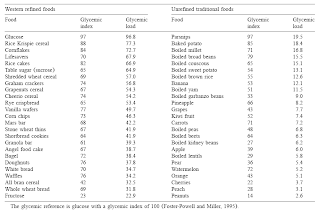
I often refer to foods rich in refined carbohydrates in this blog as among the most disease-promoting agents of modern diets. Yet, when one looks at the glycemic indices of foods rich in refined and unrefined carbohydrates, they are not all that different. The glycemic index of a carbohydrate-rich food reflects how quickly the food is digested and generate a blood glucose response. Technically, it is measured as the area under a two-hour blood glucose response curve following the consumption of a portion of the food with a fixed amount of carbohydrates. A measure that reflects much better the underlying difference between foods rich in refined and unrefined carbohydrates is the glycemic load, which is the product of the glycemic index of a food by the carbohydrate content in a 100 g portion of the food. The glycemic load is also the reason for one known fact among diabetics. If a diabetic person eats a very small amount of a high glycemic index food, he or she will have a relatively sm...

PepsiCo to reduce sugar and fat in products

I guess PepsiCo is moving ahead of the competition, but in a snail pace and in a very, very politically correct way. Will this help in any way? I doubt. It is just too little, too late. See article here . The article states that: The company also set two goals for the next 10 years: to cut the average added sugar per serving by 25 percent and saturated fat per serving by 15 percent, in addition to adding more whole grains, fruits, vegetables and low-fat dairy into its array of products. While it is nice to see more of a focus on sugar than on saturated fat, I would have preferred to see something like this: The company also set two goals for the next 5 years: to cut the average added sugar per serving by 95 percent and increase saturated fat per serving by 50 percent, in addition to adding more vegetables and full-fat dairy into its array of products. What would happen? Well, Indra Nooyi is a very smart CEO, and the company has many competent people. They know that they would probably ...

Want to improve your cholesterol profile? Replace refined carbs and sugars with saturated fat and cholesterol in your diet

Image
An interesting study by Clifton and colleagues (1998; full reference and link at the end of this post) looked at whether LDL cholesterol particle size distribution at baseline (i.e., beginning of the study) for various people was a determinant of lipid profile changes in each of two diets – one low and the other high in fat. This study highlights a few interesting points made in a previous post , which are largely unrelated to the main goal or findings of the study, but that are supported by side findings: - As one increases dietary cholesterol and fat consumption, particularly saturated fat, circulating HDL cholesterol increases significantly. This happens whether one is taking niacin or not, although niacin seems to help, possibly as an independent (not moderating) factor. Increasing serum vitamin D levels, which can be done through sunlight exposure and supplementation, are also known to increase circulating HDL cholesterol. - As one increases dietary cholesterol and fat consumption...

How much vitamin D? Vitamin D Council's recommendations

Since my recent post on problems related to vitamin D deficiency and excess I received several questions. I have also participated in several discussions in other blogs related to vitamin D in the past few days. There is a lot of consensus about vitamin D deficiency being a problem, but not much about vitamin D in excess being a problem as well. Some bloggers recommend a lot of supplementation, which may be dangerous because: (a) our body evolved to obtain most of its vitamin D from a combination of sunlight exposure and cholesterol, and thus body accumulation regulation mechanisms are not designed to deal with excessive oral supplementation; and (b) vitamin D, like many fat-soluble vitamins, accumulates in fat tissue over time, and is not easily eliminated by the body when in excess. The Vitamin D Council has the following general recommendation regarding supplementation: Take an average of 5,000 IU a day, year-round, if you have some sun exposure. If you have little, or no, sun exp...

Cancer patterns in Inuit populations: 1950-1997

Image
Some types of cancer have traditionally been higher among the Inuit than in other populations, at least according to data from the 1950s, when a certain degree of westernization had already occurred. The incidence of the following types of cancer among the Inuit has been particularly high: nasopharynx, salivary gland, and oesophageal. The high incidence of these “traditional” types of cancer among the Inuit is hypothesized to have a strong genetic basis. Nevertheless some also believe these cancers to be associated with practices that were arguably not common among the ancestral Inuit, such as preservation of fish and meat with salt. Genetic markers in the present Inuit population show a shared Asian heritage, which is consistent with the higher incidence of similar types of cancer among Asians, particularly those consuming large amounts of salt-preserved foods. (The Inuit are believed to originate from East Asia, having crossed the Bering Strait about 5,000 years ago.) The incidence o...

Applied evolutionary thinking: Darwin meets Washington

Charles Darwin, perhaps one of the greatest scholars of all time, thought about his theory of mutation, inheritance, and selection of biological traits for more than 20 years, and finally published it as a book in 1859.  At that time, many animal breeders must have said something like this: “So what? We knew this already.” In fact George Washington, who died in 1799 (many years before Darwin ’s famous book came out), had tried his hand at what today would be called “genetic engineering.” He produced at least a few notable breeds of domestic animals through selective breeding. Those include a breed of giant mules – the “Mammoth Jackstock” breed. Those mules are so big and strong that they were used to pull large boats filled with coal along artificial canals in Pennsylvania . Washington learned the basic principles of animal breeding from others, who learned it from others, and so on. Animal breeding has a long tradition. So, not only did animal breeders, like George Washington, ha...

Go see your doctor, often

As I blog about health issues, and talk with people about them, I often notice that there is a growing contempt for the medical profession. This comes in part from the fact that many MDs are still providing advice based on the mainstream assumption that saturated fat is the enemy. Much recent (and even some old) research suggests that among the main real enemies of good health are: chronic stress, refined carbs, refined sugars, industrial trans-fats, and an omega-6/omega-3 imbalance caused by consumption of industrial vegetable oils rich in omega-6 fats. Because of this disconnect, some people stop seeing their doctors regularly; others avoid doctors completely. Many rely exclusively on Internet advice, from health-related blogs (like this) and other sources. In my opinion, this is a BIG mistake. A good MD has something that no blogger who is not an MD (like me) can have. He or she has direct access to a much larger group of people, and to confidential information that can clarify thin...

Refined carbs, sugar, and cholesterol: My own experience

A few years ago I went to the doctor for a routine appointment, and I was told that my LDL cholesterol was elevated. I was in my early 40s. My lipid profile was the following - LDL: 156, HDL: 38, triglycerides: 188. The LDL was calculated. I was weighing about 210 lbs, which was too high for my height (5 ft 8 in). My blood pressure was low, as it has always been - systolic: 109, diastolic: 68. My doctor gave me the standard advice in these cases: exercise, lose weight, and, most importantly, reduce your intake of saturated fat . I was also told that I would probably have to take statins, as my high LDL likely had something to do with my genetic makeup. Again, this is quite standard, and we see it all over the place, particularly in commercials for statins. I told my doctor that I would do some research on the topic, which I am going to save for other posts. Let me get to the point, by telling you what my lipid profile is today - LDL: 123, HDL: 66 , triglycerides: 46 . Again, the LDL va...