Posts

Showing posts with the label body fat loss

Waist-to-weight ratios in pictures: The John Stone transformation

Image
John Stone is a bodybuilder and founder of a bodybuilding and fitness web site ( ). There he has provided pictures and stats of his remarkable transformation, which were used to prepare the montage below. John’s height is reported as 5' 11.5". Below the photos are the months in which they were taken, the waist circumferences in inches, the weights in lbs, and the waist-to-weight ratios (WWRs). Abhi was kind enough to provide a more detailed plot of John Stone’s WWRs ( ). Assuming that minimizing one’s WWR is healthy, an idea whose rationale was explained here before ( ), we could say that John was at his most unhealthy in the photo on the left. The second photo from the left shows a slightly more healthy state, at a reported 8 percent body fat (his lowest). The two photos on the right represent states in which John’s WWR is at its lowest, namely 0.1544. That is, in these two photos John minimized his WWR; at a reported 14 and 13.8 percent body fat, respectively. When w...

An illustration of the waist-to-weight ratio theory: The fit2fat2fit experiment

Image
In my previous blog post, I argued that one’s optimal weight may be the one that minimizes one’s waist-to-weight ratio. I built this argument based on the fact that body fat percentage is associated with lean body mass (and also weight) in a nonlinear way. The fit2fat2fit experiment ( ), provides what seems to be an interestingly way to put this optimal waist-to-weight ratio theory to test. This is due to a fortuitous event, as I explain in this post. In this experiment, Drew Manning, a personal trainer, decided to undergo a transformation where he went from what he argued was his fittest level, all the way to obese, and then back to fit again. He said that he wanted to do that so that he could better understand his clients’ struggles. This may be true, but it looks like he planned very well his experiment from a marketing perspective. His fittest level was at the start, with a weight of 193 lbs, at a height of 6 ft 2 in. That was his fittest level according to his own opinion. At...

What is your optimal weight? Maybe it is the one that minimizes your waist-to-weight ratio

There is a significant amount of empirical evidence suggesting that, for a given individual and under normal circumstances, the optimal weight is the one that maximizes the ratio below, where: L = lean body mass, and T = total mass. L / T L is difficult and often costly to measure. T can be measured easily, as one’s total weight. Through some simple algebraic manipulations, you can see below that the ratio above can be rewritten in terms of one’s body fat mass (F). L / T = (T – F) / T = 1 – F / T Therefore, in order to maximize L / T, one should maximize 1 – F / T. This essentially means that one should minimize the second term, or the ratio below, which is one’s body fat mass (F) divided by one’s weight (T). F / T So, you may say, all I have to do is to minimize my body fat percentage. The problem with this is that body fat percentage is very difficult to measure with precision, and, perhaps more importantly, body fat percentage is associated with lean body mass (and also wei...

The lowest-mortality BMI: What is its relationship with fat-free mass?

Image
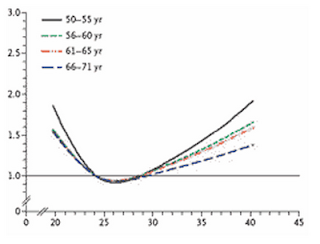
Do overweight folks live longer? It is not uncommon to see graphs like the one below, from the Med Journal Watch blog ( ), suggesting that, at least as far as body mass index (BMI) is concerned ( ), overweight folks (25 < BMI < 30) seem to live longer. The graph shows BMI measured at a certain age, and risk of death within a certain time period (e.g., 20 years) following the measurement. The lowest-mortality BMI is about 26, which is in the overweight area of the BMI chart. Note that relative age-adjusted mortality risk (i.e., relative to the mortality risk of people in the same age group), increases less steeply in response to weight variations as one becomes older. An older person increases the risk of dying to a lesser extent by weighing more or less than does a younger person. This seems to be particularly true for weight gain (as opposed to weight loss). The table below is from a widely cited 2002 article by Allison and colleagues ( ), where they describe a study of 10,169 ...

Hunger is your best friend: It makes natural foods taste delicious and promotes optimal nutrient partitioning

Image
One of the biggest problems with modern diets rich in industrial foods is that they promote unnatural hunger patterns. For example, hunger can be caused by hypoglycemic dips, coupled with force-storage of fat in adipocytes, after meals rich in refined carbohydrates. This is a double-edged post-meal pattern that is induced by, among other things, abnormally elevated insulin levels. The resulting hunger is a rather unnatural type of hunger. By the way, I often read here and there, mostly in blogs, that “insulin suppresses hunger”. I frankly don’t know where this idea comes from. What actually happens is that insulin is co-secreted with a number of other hormones. One of those, like insulin also secreted by the beta-cells in the pancreas, is amylin – a powerful appetite suppressor. Amylin deficiency leads to hunger even after a large carbohydrate-rich meal, when insulin levels are elevated. Abnormally high insulin levels – like those after a “healthy” breakfast of carbohydrate-rich cere...

If your NEAT is low, maybe you should chill

Image
I wrote most of this post a while ago, and then forgot about it. The recent blogosphere storm of comments regarding cold-induced thermogenesis caught me by surprise ( ), and provided a motivation to get this post out. Contrary to popular perception, I guess, cold-induced thermogenesis is an extensively researched topic. Some reasonably well cited references are linked here. Let us backtrack a bit. When people say that they want to lose weight, usually what they really want is to lose is body fat. However, they frequently do things that make them lose what they do not want – muscle glycogen, water, and even some muscle protein. Physical activity in general depletes muscle glycogen; even aerobic physical activity. Walking, for example, depletes muscle glycogen; but slowly, and proportionally to how fast one walks. Weight training and sprints deplete muscle glycogen much faster. Whatever depletes muscle glycogen also lowers the amount of water stored in myocytes (muscle cells), effective...