Posts

Showing posts with the label NEAT

The 14-percent advantage of eating little and then a lot: Putting it in practice
Image
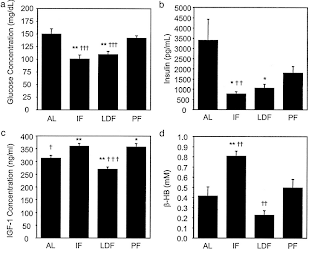
In my previous post I argued that the human body may react to “eating big” as it would to overfeeding, increasing energy expenditure by a certain amount. That increase seems to lead to a reduction in the caloric value of the meals during overfeeding; a reduction that seems to gravitate around 14 percent of the overfed amount. And what is the overfed amount? Let us assume that your daily calorie intake to maintain your current body weight is 2,000 calories. However, one day you consume 1,000 calories, and the next 3,000 – adding up to 4,000 calories in 2 days. This amounts to 2,000 calories per day on average, the weight maintenance amount; but the extra 1,000 on the second day is perceived by your body as overfeeding. So 140 calories are “lost” . The mechanisms by which this could happen are not entirely clear. Some studies contain clues; one example is the 2002 study conducted with mice by Anson and colleagues ( ), from which the graphs below were taken. In the graphs above AL refers ...

The 14-percent advantage of eating little and then a lot: Is it real?

Image
When you look at the literature on overfeeding, you see a number over and over again – 14 percent. That is approximately the increase in energy expenditure you get when you overfeed people; that is, when you feed people more calories that they need to maintain their current weight. This phenomenon is related to another interesting one: the nonlinear increase in body weight and fat mass following overfeeding after a period starvation, illustrated by the top graph below from an article by Kevin Hall ( ). The data for the squares on the top graph is from the Minnesota Starvation Experiment ( ). The graph at the bottom is based mostly on the results of a simulation, and doesn’t clearly reflect the phenomenon. Due to the significant amount of weight lost in what is called above the semistarvation stage (SS), the controlled refeeding period (CR) actually involved significant overfeeding. Nevertheless, weight was not gained right away, due to a sharp increase in energy expenditure. That is...

If your NEAT is low, maybe you should chill

Image
I wrote most of this post a while ago, and then forgot about it. The recent blogosphere storm of comments regarding cold-induced thermogenesis caught me by surprise ( ), and provided a motivation to get this post out. Contrary to popular perception, I guess, cold-induced thermogenesis is an extensively researched topic. Some reasonably well cited references are linked here. Let us backtrack a bit. When people say that they want to lose weight, usually what they really want is to lose is body fat. However, they frequently do things that make them lose what they do not want – muscle glycogen, water, and even some muscle protein. Physical activity in general depletes muscle glycogen; even aerobic physical activity. Walking, for example, depletes muscle glycogen; but slowly, and proportionally to how fast one walks. Weight training and sprints deplete muscle glycogen much faster. Whatever depletes muscle glycogen also lowers the amount of water stored in myocytes (muscle cells), effective...

Is working standing up too expensive? It could cost you as little as $10

Image
Spending too much time sitting down is clearly unnatural, particularly if you sit down on very comfortable chairs . Sitting down per se is probably natural, given the human anatomy, but not sitting down for hours in the same position. Also, comfortable furniture is an apparently benign Neolithic invention, but over several years it may stealthily contributed to the metabolic syndrome and the diseases of civilization. Getting an elevated workstation may be a bit expensive. At work, you may have to go through a bit of a battle with your employer to get it (unless you are " teh boz "), only to find out that having to work standing up all the time is not what you really wanted. That may not be very natural either. So what is one to do? One possible solution is to buy a small foldable plastic table (or chair) like the one on the figure below, which may cost you less than $10, and put it on your work desk. I have been doing this for quite a while now, and it works fine for me. The...

Low nonexercise activity thermogenesis: Uncooperative genes or comfy furniture?

Image
The degree of nonexercise activity thermogenesis ( NEAT ) seems to a major factor influencing the amount of fat gained or lost by an individual. It also seems to be strongly influenced by genetics, because NEAT is largely due to involuntary activities like fidgeting. But why should this be? The degree to which different individuals will develop diseases of civilization in response to consumption of refined carbohydrate-rich foods can also be seen as influenced by genetics. After all, there are many people who eat those foods and are thin and healthy, and that appears to be in part a family trait. But whether we consume those products or not is largely within our control. So, it is quite possible that NEAT is influenced by genetics, but the fact that NEAT is low in so many people should be a red flag. In the same way that the fact that so many people who eat refined carbohydrate-rich foods are obese should be a red flag. Moreover, modern isolated hunter-gatherers tend to have low levels...

Nonexercise activities like fidgeting may account for a 1,000 percent difference in body fat gain! NEAT eh?

Image
Some studies become classics in their fields and yet are largely missed by the popular media. This seems to be what happened with a study by Levine and colleagues (1999; full reference and link at the end of this post), which looked at the role that nonexercise activity thermogenesis (NEAT) plays in fat gain suppression. Many thanks go to Lyle McDonald for posting on this. You have probably seen on the web claims that overeating leads to fat loss, because overeating increases one’s basal metabolic rate. There are also claims that food has a powerful thermic effect, due to the energy needed for digestion, absorption and storage of nutrients; this is also claimed to lead to fat loss. There is some truth to these claims, but the related effects are very small compared with the effects of NEAT. Ever wonder why there are some folks who seem to eat whatever they want, and never get fat? As it turns out, it may be primarily due to NEAT! NEAT is associated with fidgeting, maintenance of postu...