Posts

Showing posts with the label carbohydrates

Trip to South Korea: Hidden reasons for the leanness of its people

Image
In September last year (2012) I went to South Korea to speak about nonlinear data analysis with WarpPLS ( ), initially for business and engineering faculty and students at Korea University in Seoul, and then as a keynote speaker at the HumanCom 2012 Conference ( ) in Gwangju. Since Seoul is in the north part of the country, and Gwangju in the south, I had the opportunity to see quite a lot of the land and the people in this beautiful country. (Korea University’s main entrance, Anam campus) (In front of Korea University’s main Business School building) Korea University is one of the most prestigious universities in South Korea. In the fields of business and engineering, it is arguably the most prestigious. It also has a solid international reputation, attracting a large number of highly qualified foreign students. I wanted to take this opportunity and try to understand why obesity prevalence is so low in South Korea, which is a common characteristic among Southeast Asian countries, e...

How to make white rice nutritious

Image
One of the problems often pointed out about rice, and particularly about white rice, is that its nutrition content is fairly low. It is basically carbohydrates with some trace amounts of protein. A 100-g portion of cooked white rice will typically deliver 28 g of carbohydrates, with zero fiber, and 3 g of protein. The micronutrient content of such a portion leaves a lot to be desired when compared with fruits and vegetables, as you can see below (from Nutritiondata.com). Keep in mind that this is for 100 g of “enriched” white rice; the nutrients you see there, such as manganese, are added. White rice is rice that has had its husk, bran, and germ removed. This prevents spoilage and thus significantly increases its shelf life. As it happens, it also significantly reduces both its nutrition and toxin content. White rice is one of the refined foods with the lowest toxin content. Another interesting property of white rice is that it absorbs moisture to the tune of about 2.5 times its weig...

Rice consumption and health

Image
Carbohydrate-rich foods lead to the formation of blood sugars after digestion (e.g., glucose, fructose), which are then used by the liver to synthesize liver glycogen. Liver glycogen is essentially liver-stored sugar, which is in turn used to meet the glucose needs of the human brain – about 5 g/h for the average person. (Source: Wikipedia) When one thinks of the carbohydrate content of foods, there are two measures that often come to mind: the glycemic index and the glycemic load. Of these two, the first, the glycemic index, tends to get a lot more attention. Some would argue that the glycemic load is a lot more important, and that rice, as consumed in Asia, may provide a good illustration of that importance. A 100-g portion of cooked rice will typically deliver 28 g of carbohydrates, with zero fiber, and 3 g of protein. By comparison, a 100-g portion of white Italian bread will contain 54 g of carbohydrates, with 4 g of fiber, and 10 g of protein – the latter in the form of gluten. A...

Hunger is your best friend: It makes natural foods taste delicious and promotes optimal nutrient partitioning

Image
One of the biggest problems with modern diets rich in industrial foods is that they promote unnatural hunger patterns. For example, hunger can be caused by hypoglycemic dips, coupled with force-storage of fat in adipocytes, after meals rich in refined carbohydrates. This is a double-edged post-meal pattern that is induced by, among other things, abnormally elevated insulin levels. The resulting hunger is a rather unnatural type of hunger. By the way, I often read here and there, mostly in blogs, that “insulin suppresses hunger”. I frankly don’t know where this idea comes from. What actually happens is that insulin is co-secreted with a number of other hormones. One of those, like insulin also secreted by the beta-cells in the pancreas, is amylin – a powerful appetite suppressor. Amylin deficiency leads to hunger even after a large carbohydrate-rich meal, when insulin levels are elevated. Abnormally high insulin levels – like those after a “healthy” breakfast of carbohydrate-rich cere...

Triglycerides, VLDL, and industrial carbohydrate-rich foods

Image
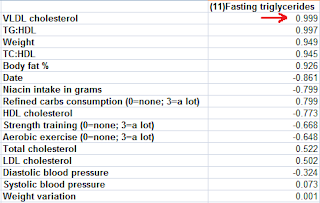
Below are the coefficients of association calculated by HealthCorrelator for Excel (HCE) for user John Doe. The coefficients of association are calculated as linear correlations in HCE ( ). The focus here is on the associations between fasting triglycerides and various other variables. Take a look at the coefficient of association at the top, with VLDL cholesterol, indicated with a red arrow. It is a very high 0.999. Whoa! What is this – 0.999! Is John Doe a unique case? No, this strong association between fasting triglycerides and VLDL cholesterol is a very common pattern among HCE users. The reason is simple. VLDL cholesterol is not normally measured directly, but typically calculated based on fasting triglycerides, by dividing the fasting triglycerides measurement by 5. And there is an underlying reason for that - fasting triglycerides and VLDL cholesterol are actually very highly correlated, based on direct measurements of these two variables. But if VLDL cholesterol is calcula...

There is no doubt that abnormally elevated insulin is associated with body fat accumulation

Image
For as long as diets existed there have been influential proponents, or believers, who at some point had what they thought were epiphanies. From that point forward, they disavowed the diets that they formally endorsed. Low carbohydrate dieting seems to be in this situation now. Among other things, it has been recently “discovered” that the idea that insulin drives fat into body fat cells is “wrong”. Based on some of the comments I have been receiving lately, apparently a few readers think that I am one of those “enlightened”. If you are interested in what I have been eating, for quite some time now, just click on the link at the top of this blog that refers to my transformation. It is essentially high in all macronutrients on days that I exercise, and low in carbohydrates and calories on days that I don’t. It is a cyclic approach that works for me; calorie surpluses on some days and calorie deficits on other days. But let me set the record straight regarding what I think: there is no ...

Dietary protein does not become body fat if you are on a low carbohydrate diet

By definition LC is about dietary carbohydrate restriction. If you are reducing carbohydrates, your proportional intake of protein or fat, or both, will go up. While I don’t think there is anything wrong with a high fat diet, it seems to me that the true advantage of LC may be in how protein is allocated, which seems to contribute to a better body composition. LC with more animal protein and less fat makes particularly good sense to me. Eating a variety of unprocessed animal foods, as opposed to only muscle meat from grain-fed cattle, will get you that. In simple terms, LC with more protein, achieved in a natural way with unprocessed foods, means more of the following in one's diet: lean meats, seafood and vegetables. Possibly with lean meats and seafood making up more than half of one’s protein intake. Generally speaking, large predatory fish species (e.g., various shark species, including dogfish) are better avoided to reduce exposure to toxic metals. Organ meats such as beef liv...

What is a good low carbohydrate diet? It is a low calorie one

My interview with Jimmy Moore should be up on the day that this post becomes available. (I usually write my posts on weekends and schedule them for release at the beginning of the following weeks.) So the time is opportune for me to try to aswer this question: What is a good low carbohydrate diet? For me, and many people I know, the answer is: a low calorie one. What this means, in simple terms, is that a good low carbohydrate diet is one with plenty of seafood and organ meats in it, and also plenty of veggies. These are low carbohydrate foods that are also naturally low in calories. Conversely, a low carbohydrate diet of mostly beef and eggs would be a high calorie one. Seafood and organ meats provide essential fatty acids and are typically packed with nutrients. Because of that, they tend to be satiating. In fact, certain organ meats, such as beef liver, are so packed with nutrients that it is a good idea to limit their consumption. I suggest eating beef liver once or twice a we...

The China Study II: Carbohydrates, fat, calories, insulin, and obesity

Image
The “great blogosphere debate” rages on regarding the effects of carbohydrates and insulin on health. A lot of action has been happening recently on Peter’s blog , with knowledgeable folks chiming in, such as Peter himself, Dr. Harris, Dr. B.G. (my sista from anotha mista), John, Nigel, CarbSane, Gunther G., Ed, and many others. I like to see open debate among people who hold different views consistently, are willing to back them up with at least some evidence, and keep on challenging each other’s views. It is very unlikely that any one person holds the whole truth regarding health matters. Unfortunately this type of debate also confuses a lot of people, particularly those blog lurkers who want to get all of their health information from one single source. Part of that “great blogosphere debate” debate hinges on the effect of low or high carbohydrate dieting on total calorie consumption. Well, let us see what the China Study II data can tell us about that, and about a few other things....

How much dietary protein can you store in muscle? About 15 g/d if you are a gifted bodybuilder

Image
Let us say you are one of the gifted few who are able to put on 1 lb of pure muscle per month, or 12 lbs per year, by combining strength training with a reasonable protein intake. Let us go even further and assume that the 1 lb of muscle that we are talking about is due to muscle protein gain, not glycogen or water. This is very uncommon; one has to really be genetically gifted to achieve that. And you do that by eating a measly 80 g of protein per day. That is little more than 0.5 g of protein per lb of body weight if you weigh 155 lbs; or 0.4 per lb if you weigh 200 lbs. At the end of the year you are much more muscular. People even think that you’ve been taking steroids; but that just came naturally. The figure below shows what happened with the 80 g of protein you consumed every day. About 15 g became muscle (that is 1 lb divided by 30) … and 65 g “disappeared”! Is that an amazing feat? Yes, it is an amazing feat of waste, if you think that the primary role of protein is to build m...