Posts

Showing posts with the label intermittent fasting

No fat gain while eating well during the Holiday Season: Palatability isolines, the 14-percent advantage, and nature’s special spice

Image
Like most animals, our Paleolithic ancestors had to regularly undergo short periods of low calorie intake. If they were successful at procuring food, those ancestors alternated between periods of mild famine and feast. As a result, nature allowed them to survive and leave offspring. The periods of feast likely involved higher-than-average consumption of animal foods, with the opposite probably being true in periods of mild famine. Almost anyone who adopted a low carbohydrate diet for a while will tell you that they find foods previously perceived as bland, such as carrots or walnuts, to taste very sweet – meaning, to taste very good. This is a special case of a more general phenomenon. If a nutrient is important for your body, and your body is deficient in it, those foods that contain the nutrient will taste very good. This rule of thumb applies primarily to foods that contributed to selection pressures in our evolutionary past. Mostly these were foods available in our Paleolithic ev...

Daniel Suelo, the man who quit money, seems remarkably healthy

Image
Daniel James Shellabarger (better known as Daniel Suelo) is portrayed in the bestselling 2012 nonfiction book by Mark Sundeen titled “The Man Who Quit Money” ( ). Apparently Suelo stopped using money in 2000, and lives in a cave near the city of Moab in Utah. His diet comprises primarily wild vegetables and fruits, insects, and road kill; as well as discarded or donated food he gets from others when he visits the city. The photo below is from a recent BBC documentary. An interesting 2006 YouTube clip on Suelo is titled “Moneyless in Moab” ( ). Suelo is listed as having been born in 1961 ( ), and the photo above appears to have been taken in 2012. If these dates are correct, he is 51 in the photo above. I cannot help but think that he looks remarkably healthy. The 40-50 age period is one that often sets the stage for many diseases of civilization in urban societies. Suelo’s decision seems like a radical one, at least to me. There are always complex motivations behind radical decisions. ...

The 14-percent advantage of eating little and then a lot: Putting it in practice

Image
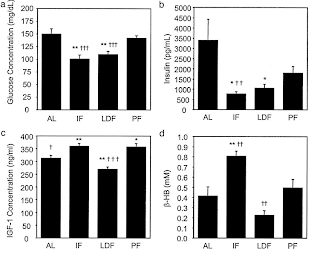
In my previous post I argued that the human body may react to “eating big” as it would to overfeeding, increasing energy expenditure by a certain amount. That increase seems to lead to a reduction in the caloric value of the meals during overfeeding; a reduction that seems to gravitate around 14 percent of the overfed amount. And what is the overfed amount? Let us assume that your daily calorie intake to maintain your current body weight is 2,000 calories. However, one day you consume 1,000 calories, and the next 3,000 – adding up to 4,000 calories in 2 days. This amounts to 2,000 calories per day on average, the weight maintenance amount; but the extra 1,000 on the second day is perceived by your body as overfeeding. So 140 calories are “lost” . The mechanisms by which this could happen are not entirely clear. Some studies contain clues; one example is the 2002 study conducted with mice by Anson and colleagues ( ), from which the graphs below were taken. In the graphs above AL refers ...

The 14-percent advantage of eating little and then a lot: Is it real?

Image
When you look at the literature on overfeeding, you see a number over and over again – 14 percent. That is approximately the increase in energy expenditure you get when you overfeed people; that is, when you feed people more calories that they need to maintain their current weight. This phenomenon is related to another interesting one: the nonlinear increase in body weight and fat mass following overfeeding after a period starvation, illustrated by the top graph below from an article by Kevin Hall ( ). The data for the squares on the top graph is from the Minnesota Starvation Experiment ( ). The graph at the bottom is based mostly on the results of a simulation, and doesn’t clearly reflect the phenomenon. Due to the significant amount of weight lost in what is called above the semistarvation stage (SS), the controlled refeeding period (CR) actually involved significant overfeeding. Nevertheless, weight was not gained right away, due to a sharp increase in energy expenditure. That is...

Gaining muscle and losing fat at the same time: A more customized approach based on strength training and calorie intake variation

Image
In the two last posts I discussed the idea of gaining muscle and losing fat at the same time ( ) ( ). This post outlines one approach to make that happen, based on my own experience and that of several HCE ( ) users. This approach may well be the most natural from an evolutionary perspective. But first let us address one important question: Why would anyone want to reach a certain body weight and keep it constant, resorting to the more difficult and slow strategy of “turning fat into muscle”, so to speak? One could simply keep on losing fat, without losing or gaining muscle, until he or she reaches a very low body fat percentage (e.g., a single-digit body fat percentage, for men). Then he or she could go up from there, slowly putting on muscle. The reason why it is advisable to reach a certain body weight and keep it constant is that, below a certain weight, one is likely to run into nutrient deficiencies . Non-exercise energy expenditure is proportional to body weight. As you keep on...

Strength training plus fasting regularly, and becoming diabetic!? No, it is just compensatory adaptation at work

Image
One common outcome of doing glycogen-depleting exercise (e.g., strength training, sprinting) in combination with intermittent fasting is an increase in growth hormone (GH) levels. See this post for a graph showing the acute effect on GH levels of glycogen-depleting exercise. This effect applies to both men and women, and is generally healthy, leading to improvements in mood and many health markers. It is a bit like GH therapy, with GH being “administered” to you by your own body. Both glycogen-depleting exercise and intermittent fasting increase GH levels; apparently they have an additive effect when done together. Still, a complaint that one sees a lot from people who have been doing glycogen-depleting exercise and intermittent fasting for a while is that their fasting blood glucose levels go up. This is particularly true for obese folks (after they lose body fat), as obesity tends to be associated with low GH levels, although it is not restricted to the obese. In fact, many people d...

Do you lose muscle if you lift weights after a 24-hour fast? Probably not if you do that regularly

Image
Compensatory adaptation (CA)  is an idea that is useful in the understanding of how the body reacts to inputs like dietary intake of macronutrients and exercise. CA is a complex process, because it involves feedback loops, but it leads to adaptations that are fairly general, applying to a large cross-section of the population. A joke among software developers is that the computer does exactly what you tell it to do, but not necessarily what you want it to do. Similarly, through CA your body responds exactly to the inputs you give it, but not necessarily in the way you would like it to respond. For example, a moderate caloric deficit may lead to slow body fat loss, while a very high caloric deficit may bring body fat loss to a halt. Strength training seems to lead to various adaptations, which can be understood through the lens provided by CA. One of them is a dramatic increase in the ability of the body to store glycogen, in both liver and muscle. Glycogen is the main fuel used by ...

Intermittent fasting, engineered foods, leptin, and ghrelin

Image
Engineered foods are designed by smart people, and the goal is not usually to make you healthy; the goal is to sell as many units as possible. Some engineered foods are “fortified” with the goal of making them as healthy as possible. The problem is that food engineers are competing with many millions of years of evolution, and evolution usually leads to very complex metabolic processes. Evolved mechanisms tend to be redundant, leading to the interaction of many particles, enzymes, hormones etc. Natural foods are not designed to make you eat them nonstop. Animals do not want to be eaten (even these odd-looking birds below). Most plants do not “want” their various nutritious parts to be eaten. Fruits are exceptions, but plants do not want one single individual to eat all their fruits. That compromises seed dispersion. Multiple individual fruit eaters enhance seed dispersion. Plants "want" one individual animal to eat some of their fruits and then move on, so that other individu...

Intermittent fasting as a form of liberation

Image
I have been doing a lot of reading over the years on isolated hunter-gatherer populations; see three references at the end of this post, all superb sources (Chagnon’s book on the Yanomamo, in particular, is an absolute page turner). I also take every opportunity I have to talk with anthropologists and other researchers who have had field experience with hunter-gatherer groups. Even yesterday I was talking to a researcher who spent many years living among isolated native Brazilian groups in the Amazon. Maybe I have been reading too much into those descriptions, but it seems to me that one distinctive feature of many adults in hunter-gatherer populations, when compared with adults in urban populations, is that the hunter-gatherers are a lot less obsessed with food. Interestingly, this seems to be a common characteristic of physically active children. They want to play, and eating is often an afterthought, an interruption of play. Sedentary children, who play indoors, can and often want t...

Body fat and disease: How much body fat can I lose in one day?

Image
Body fat is not an inert deposit of energy. It can be seen as a distributed endocrine organ. Body fat cells, or adipocytes, secrete a number of different hormones into the bloodstream. Major hormones secreted by adipose tissue are adiponectin and leptin. Estrogen is also secreted by body fat, which is one of the reasons why obesity is associated with infertility. (Yes, abnormally high levels of estrogen can reduce fertility in both men and women.) Moreover, body fat secretes tumor necrosis factor-alpha, a hormone that is associated with generalized inflammation and a number of diseases, including cancer, when in excess. The reduction in circulating tumor necrosis factor-alpha and other pro-inflammatory hormones as one loses weight is one reason why non-obese people usually experience fewer illness symptoms than those who are obese in any given year, other things being equal. For example, the non-obese will have fewer illness episodes that require full rest during the flu season. In tho...

Muscle loss during short-term fasting

This is an issue that often comes up in online health discussions, and was the topic of a conversation I had the other day with a friend about some of the benefits of intermittent fasting . Can the benefits of intermittent fasting be achieved without muscle loss? The answer is “yes”, to the best of my knowledge. Even if you are not interested in bulking up or becoming a bodybuilder, you probably want to keep the muscle tissue you have. As a norm, muscle takes a long time, and effort, to build. It is generally easier to lose muscle than it is to gain it. Fat, on the other hand, can be gained very easily. Body fat percentage is positively correlated with measures of inflammation markers and the occurrence of various health problems. Since muscle tissue makes up lean body mass, which excludes fat, it is by definition negatively correlated with inflammation markers and health problems. As muscle mass increases, so does health; as long as the increase in muscle mass is “natural” – i.e., not...

Intermittent fasting and reduced inflammation

A recent post  on the Primal Wisdom blog led me to do go back to some of the research on an approach to dieting that I tried myself, with some positive results. The approach is known as intermittent fasting (IF). I also found an excellent blog post by Dr. Michael Eades on IF (see  here ). Typically IF involves fasting every other day. On the non-fasting days, food and water consumption is not restricted in any way. On fasting days, only water is consumed. Variations of this approach usually involve replacing water with juice, and having an eating window of only a few hours within longer periods – e.g., fasting 19 hours and then eating during a window of 5 hours, for each period of 24 hours. IF is different from calorie restriction (CR), in that in the latter total daily calorie intake is restricted to a somewhat fixed amount, below one’s basal metabolic rate (the number of calories needed to maintain one’s current weight). In CR the calorie restriction is not normally ach...